By Staff Writer | Smart News Liberia
MONROVIA – Finance and Development Planning Minister Augustine Kpehe Ngafuan, Liberia Revenue Authority Commissioner General Dorbor Jallah, and Central Bank of Liberia Executive Governor Henry F. Saamoi have responded to the explosive findings contained in the General Auditing Commission audit report on Liberia’s revenue collection and reconciliation systems, admitting serious operational weaknesses while outlining sweeping reforms and accountability measures aimed at restoring public confidence.
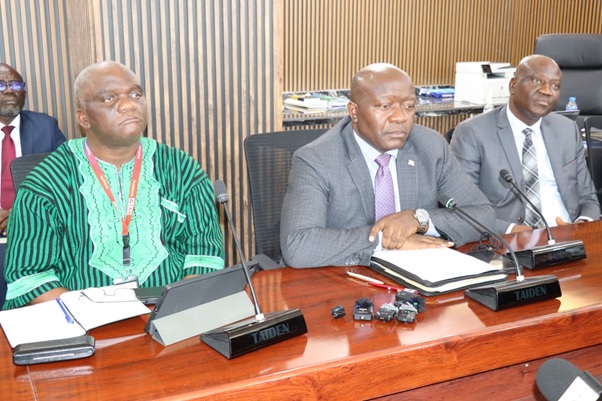
The revelation emerged Tuesday, May 19, 2026, during a joint press conference in Monrovia, where the three government financial institutions publicly responded for the first time to the General Auditing Commission audit titled “Compliance Audit Report on the Government of Liberia Revenue Collection and Reconciliation Processes,” covering the period from July 1, 2018, to December 31, 2024.
Dorbor Jallah, Augustine Kpehe Ngafuan, and Henry F. Saamoi described the audit as a critical milestone in strengthening transparency, accountability, and public financial integrity, while admitting that the report uncovered systemic weaknesses and operational failures affecting Liberia’s revenue management systems.
According to a joint statement from the Liberia Revenue Authority, the Ministry of Finance and Development Planning, and the Central Bank of Liberia, concerns first surfaced in late 2024 after the institutions detected discrepancies between revenue figures reported in the Tax Administration System (TAS) and deposits reflected in the Government’s Consolidated Revenue Account at the Central Bank of Liberia.
“As custodians of public trust, we could not and would not ignore these concerns,” the institutions declared during the press conference, emphasizing that immediate action was taken once the irregularities were identified.
They disclosed that on January 6, 2025, the Ministry of Finance formally requested an independent investigation from the GAC into variances between TAS-reported revenues and actual government deposits. The institutions explained that the request was intended to ensure a full and impartial review capable of identifying the source of the discrepancies and strengthening the integrity of Liberia’s revenue collection chain.
The institutions further revealed that the Auditor General informed them that the GAC was already conducting an extensive audit covering the 2018 to 2023 fiscal periods, but later agreed to extend the review through 2024 because of the seriousness and sensitivity of the issues involved.
Although the government initially anticipated the audit would be completed by mid-2025, authorities said the GAC requested additional time to conduct what officials described as a thorough, independent, and technically rigorous review process.
The audit reportedly uncovered several troubling issues, including discrepancies between revenues recorded in Transitory Bank Accounts (TBA) and the General Revenue Account (GRA), inconsistencies between the Tax Administration System and the General Revenue Account, unauthorized withdrawals from government accounts, untimely remittances of public funds, and irregular reversal transactions involving both transitory and revenue accounts.
Additional findings exposed variances between bills and payments processed through ASYCUDA and the Liberia Integrated Tax Administration System (LITAS), as well as inconsistencies between customs revenue receipts and tax administration records. Officials admitted that the findings confirmed “systemic weaknesses, reconciliation gaps, and operational deficiencies” throughout Liberia’s revenue collection and settlement systems.
In response, the government announced that President Joseph Nyuma Boakai has been fully briefed on the audit findings and has approved forwarding the report to the Ministry of Justice and the Liberia Anti-Corruption Commission (LACC) for further investigation.
According to the joint statement, the Justice Ministry and the LACC are expected to determine whether the findings point to fraud or criminal conduct and, where necessary, ensure that individuals found culpable are prosecuted. “We have reviewed and endorsed the audit’s recommendations,” the institutions stated, reaffirming government’s commitment to accountability and public sector reform.
Meanwhile, the three financial institutions disclosed that several corrective measures had already begun even before the audit was finalized. These reforms include revised banking agreements with commercial banks governing transitory accounts and revenue sweep timelines, mandatory daily sweep reports to improve monitoring and reconciliation, and expanded deployment of the Automated System for Customs Data (ASYCUDA) across major customs and border points.
The Liberia Revenue Authority, the Ministry of Finance and Development Planning, and the Central Bank of Liberia also revealed that the Liberia Integrated Tax Administration System (LITAS) is being expanded across regional tax offices, while ASYCUDA is being upgraded to Version 4.4 to enable direct electronic integration with commercial banks and the Central Bank for automated transaction-level reconciliation and validation.
Additionally, the institutions announced plans to integrate LITAS, SIGTAS, ASYCUDA, IFMIS, transitory accounts, and the General Revenue Account into a unified real-time reconciliation framework aimed at reducing vulnerabilities and strengthening transparency across Liberia’s public financial management system.
In another significant disclosure, the three institutions confirmed that the government is in advanced discussions with private sector firms specializing in revenue tracking and reconciliation systems to address technological and operational weaknesses identified by the audit. Among the entities under consideration is John S. Morlu LLC, headed by former Auditor General John S. Morlu II.
The institutions noted that these engagements were intentionally delayed until the audit findings were released to ensure that proposed technological solutions directly respond to the vulnerabilities identified.
They also praised the General Auditing Commission and its audit team for their professionalism, courage, diligence, and commitment in carrying out what officials described as one of the most complex and sensitive audits in recent years. The institutions reaffirmed their full commitment to cooperation as reconciliation, reform, and accountability efforts continue within Liberia’s public financial management system.