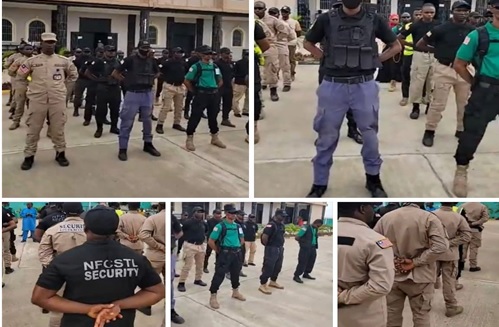
MONROVIA – The emergence of a group calling itself the “Fulani National Security of Liberia” raises serious institutional questions that cannot be brushed aside as mere misunderstanding. In a sovereign republic, the authority to organize, train, and deploy security structures rests exclusively with the State. That authority is not cultural. It is constitutional.
Liberia’s security architecture is clearly defined. The Liberia National Police, the Armed Forces of Liberia, and other statutory agencies operate under laws enacted by the Legislature and supervised by the Executive. No ethnic community, regardless of its history of peaceful coexistence, can assume a national security identity outside that legal framework.
The issue, therefore, is not whether the Fula community is peaceful or entrepreneurial. The issue is whether any ethnic-based structure should adopt a name and posture that implies national security authority. Words matter. Uniforms matter. Military-style formations matter. In fragile democracies, symbolism can carry consequences.
If today one community establishes a “National Security” structure under its ethnic identity, what prevents tomorrow’s emergence of Lorma National Security, Mandingo National Security, Kru National Security, or Krahn National Security? The danger is not immediate violence. The danger is normalization. Once such structures become acceptable, the state’s monopoly over organized force begins to erode.
The Fulani Forum’s clarification attempts to frame the matter as a simple community watch initiative. Community watch groups are not new in Liberia. Many neighborhoods cooperate with the police to curb petty crime. But there is a fundamental difference between a neighborhood watch and an entity branding itself with national security authority while conducting what appears to be military-style drills.
This is why the conversation must shift from emotion to legality. If the group is legally registered, under what statute? If it is licensed, under what regulatory framework? If it operates in coordination with state security, where is the official authorization? These are not inflammatory questions. They are constitutional necessities.
Liberia’s history makes this discussion even more sensitive. The country has endured years of civil conflict where non state armed groups fractured national unity. Any structure that resembles parallel security formation regardless of intent must be scrutinized with seriousness and transparency.
That is why the responsibility now rests squarely with the Unity Party–led administration under Joseph Boakai. The government must investigate and publicly clarify whether this entity has legal standing, what its mandate is, and whether its activities comply with national security laws. Silence or vague reassurance will only deepen public suspicion.
The Ministry of Justice, the national security apparatus, and the Legislature owe the public an update. If the group is harmless and fully compliant, the government should say so clearly. If it is improperly constituted, corrective measures must be taken immediately.
This is not about profiling the Fula community. It is about preserving the integrity of state institutions. When security becomes ethnicized even symbolically, it weakens the shared national identity that Liberia has struggled to rebuild.
National security must remain national. It cannot be segmented along tribal or communal lines. Once that boundary blurs, the precedent becomes far more dangerous than any single group’s intentions.
Liberia must learn from its past and protect its future. Investigate. Clarify. Enforce the law. And above all, ensure that the monopoly of organized force remains where it belongs with the Republic and with the Republic alone.