By Our Reporter | Smart News Liberia
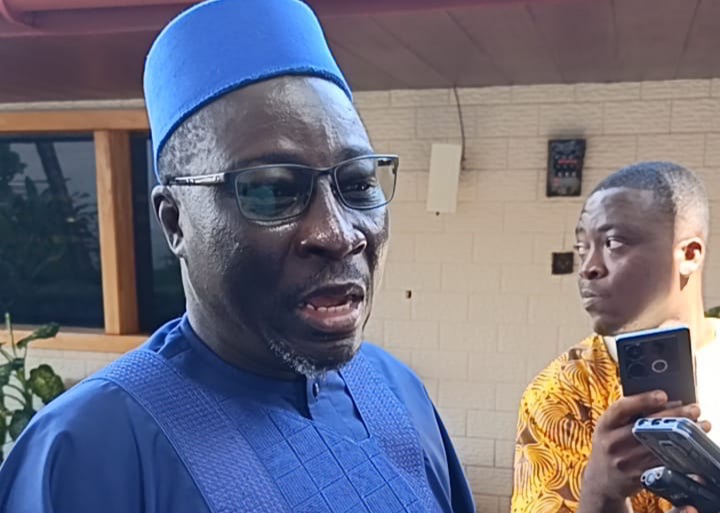
MONROVIA – The Director General of the Intergovernmental Action Group against Money Laundering in West Africa (GIABA), Edwin Harris, has issued a strong warning over the growing exposure of public procurement systems to money laundering and terrorism financing, describing the sector as one of the most vulnerable channels for illicit financial flows in the sub-region.
Speaking Monday, June 8, 2026, at the Regional Workshop for the Validation of the GIABA Guidebook on Anti-Money Laundering and Countering the Financing of Terrorism (AML/CFT) in Public Procurement at The Cape Hotel in Monrovia, Harris praised the Government and people of Liberia for hosting the high-level regional engagement and reaffirming commitment to the fight against financial crimes.
“I would like to express my profound gratitude to the Government and people of the Republic of Liberia for their warm hospitality and steadfast political leadership and commitment they continue to demonstrate in the fight against money laundering and terrorism financing in West Africa,” Harris stated.
Harris warned that public procurement systems across West Africa remain highly exposed due to weak oversight structures, opaque processes, and systemic corruption. He noted that procurement accounts for approximately 12 percent of GDP across West African member states, making it one of the largest channels for public expenditure and, consequently, a major target for exploitation.
“Public procurement is one of the most vulnerable corridors for illicit financial flows in West Africa,” he said. “The concentration of public funds, opaque processes, weak oversight and endemic corruption create fertile ground for money laundering, fraud and illicit financial flows that drain our public coffers and undermine the delivery of essential services to our citizens.”
He further warned that criminals continue to exploit procurement systems through the use of shell companies, front entities, hidden beneficial ownership structures, contract manipulation, inflated invoices, and other fraudulent practices designed to disguise illicit proceeds.
“Criminals continue to find ways and means to systematically exploit such vulnerabilities,” Harris said. “They create shell companies and front entities. They conceal beneficial ownership. They manipulate tender processes, split contracts, inflate invoices, and launder illicit proceeds through payment streams that appear legitimate.”
He cautioned that such practices undermine national development efforts, adding that essential public services such as schools, roads, and hospitals are being compromised through corruption-driven financial schemes.
West Africa, he revealed, loses an estimated USD 50 billion annually to illicit financial flows, a figure he said far exceeds the total development aid received by the region. He noted that a significant portion of these losses is linked to weaknesses in public procurement systems.
To address the challenge, Harris highlighted the newly validated GIABA Procurement Guidebook on AML/CFT as a practical regional tool designed to strengthen detection, prevention, and response mechanisms across procurement processes.
“The Guidebook has been developed as a pragmatic, actionable, and regionally owned technical reference to help member states detect, prevent, and respond to money laundering risks at every stage of the procurement cycle,” he explained.
He said the guidebook emphasizes enhanced due diligence, beneficial ownership transparency, integrity screening, inter-agency coordination, and the adoption of technology and e-procurement systems to improve transparency and accountability.
Harris also stressed the importance of international cooperation and information sharing in tackling cross-border financial crimes.
Over the course of the workshop, participants are expected to validate money laundering and terrorism financing typologies, develop a shared red-flag glossary, strengthen risk-based controls, and design national action plans for implementation.
He urged participants to ensure that the outcomes of the workshop translate into concrete action rather than remain at the level of discussion.
“By the end of this workshop, we must walk away with more than goodwill. We must walk away with a formally adopted Guidebook and a strong regional consensus that opacity in procurement is no longer a safe harbour for money laundering,” Harris stated.
He called on procurement authorities, financial intelligence units, audit institutions, and parliamentary oversight bodies to strengthen coordination and enforcement, noting that oversight without enforcement remains ineffective.
“Audit without follow-up is not meaningful. Oversight without enforcement lacks impact,” he said, adding that intelligence reports must lead to investigations, prosecutions, and asset recovery actions.
Harris concluded by thanking partners, including SECFIN Africa and GIABA’s Directorate of Policy Research, for their technical and financial contributions to the development of the guidebook and organization of the workshop, while urging participants to remain committed throughout the sessions.