

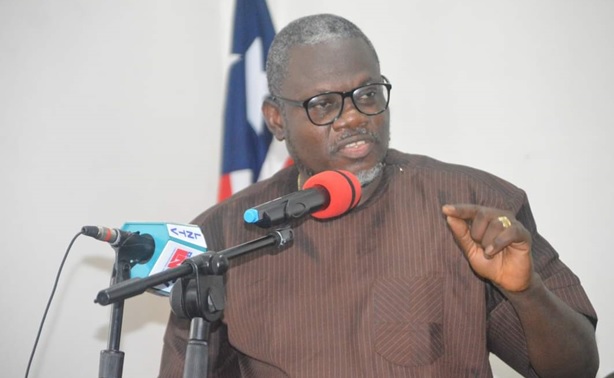
MONROVIA, Liberia — Information Minister Jerolinmek Piah’s declaration that no government can solve every problem facing Liberia within a single six-year term may sound reasonable in principle, but it raises a more fundamental question: Is the Boakai administration managing public expectations, or is it adequately accounting for its performance?
Speaking to reporters at the Ministry of Information on Thursday upon returning from the United States, Piah defended President Joseph Nyuma Boakai’s participation in the 81st United Nations General Assembly, expressing disappointment that educated citizens and professionals were questioning the value of the President’s international engagement.
“Not even our government can fix every issue facing this country in just six years,” Piah stated, pointing to the United States as an example of a developed nation that continues to face significant challenges despite its vast resources.
The argument is not entirely without merit. Liberia’s economic difficulties, infrastructure deficits, unemployment, weak public services, and governance challenges developed over many years. No president can reasonably promise to eliminate every national problem within six years.
But the real question is not whether President Boakai can fix everything in six years. It is whether his government is making meaningful progress on the problems it promised Liberians it would address.
That distinction is central to the accountability expected in a democracy.
THE SIX-YEAR ARGUMENT: EXPLANATION OR DEFLECTION?
Piah’s statement invites a broader debate about the relationship between the limitations of government and the obligations of elected leaders.
Liberians did not elect President Boakai with the expectation that every problem would disappear overnight. However, citizens have a legitimate right to demand evidence that their government is implementing its promises, using public resources responsibly, and improving living conditions.
The fact that a country cannot solve every problem within six years does not excuse delays, unfulfilled commitments, weak implementation, or the failure to explain why particular targets have not been achieved.
The government must therefore demonstrate what it has accomplished, what remains unfinished, what obstacles it faces, and what measurable targets it intends to meet before the end of its term.
Without such evidence, appeals for patience risk sounding like requests for political understanding without sufficient proof of progress.
BOAKAI’S UN TRIP: WHERE ARE THE TANGIBLE RESULTS?
The immediate issue prompting Piah’s response is criticism of President Boakai’s attendance at the 81st UN General Assembly.
International diplomacy is an important responsibility of the presidency. Liberia must maintain relations with other countries, attract investment, pursue development partnerships, and represent its interests in international institutions.
However, the importance of diplomacy does not make presidential travel immune from public scrutiny.
Liberians are entitled to ask what concrete benefits emerged from the President’s participation in the UN gathering.
Did the engagements produce new investment commitments? Were agreements reached that could create jobs or strengthen the economy? Were development partnerships secured, or were existing commitments advanced? What specific outcomes can the government document?
These are legitimate questions, not necessarily evidence of hostility toward the President or a rejection of international diplomacy.
If the government believes the trip was successful, it should publish a clear account of its outcomes, including any agreements reached, commitments secured, and follow-up actions required.
The success of a presidential trip should ultimately be assessed by its documented results, not simply by the fact that the President attended an international gathering.
WHY COMPARE LIBERIA WITH THE UNITED STATES?
Piah’s reference to the United States highlights a valid point: even wealthy nations struggle with persistent social, economic, and political problems.
But the comparison has limits.
The United States has a vastly different economic base, institutional capacity, infrastructure, and access to financial resources than Liberia. Its continuing problems do not, by themselves, explain whether Liberia’s government is performing effectively.
The more useful comparison is between the promises made by the Boakai administration and the progress it can demonstrate in fulfilling them.
Liberians need to know whether government institutions are functioning more effectively, whether public services are improving, whether infrastructure projects are advancing, and whether the administration is delivering on its stated priorities.
The relevant question is not whether Liberia has become problem-free. It is whether the government is making demonstrable progress within the resources and time available to it.
THREE YEARS INTO THE ADMINISTRATION, WHAT SHOULD LIBERIANS EXPECT?
President Boakai took office in January 2024. By October 2026, his administration had been in power for approximately two years and nine months.
That period is long enough for citizens to begin assessing implementation, although major infrastructure and institutional reforms may require more time to produce their full effects.
The government should be able to provide progress reports showing:
– Infrastructure: Which roads, bridges, schools, hospitals, and other public projects have been completed, and which remain delayed?
– Employment: What measurable progress has been made in creating opportunities for young Liberians?
– Education and health: What improvements have occurred in access, staffing, facilities, and the quality of public services?
– Public finances: How are government revenues being spent, and what results are taxpayers receiving?
– Governance: What concrete steps have been taken to strengthen transparency, combat corruption, and ensure that public officials are held accountable?
– Campaign commitments: Which major promises have been fulfilled, which are in progress, and which have not been implemented?
These questions do not assume that the administration has achieved nothing. They establish the evidence necessary to assess its record fairly.
The government should be given credit where its achievements are documented and held accountable where commitments remain unfulfilled.
CRITICISM IS NOT NECESSARILY DISLOYALTY
Perhaps the most contentious aspect of Piah’s remarks is his expressed disappointment that educated citizens and professionals are questioning the value of the President’s UN trip.
Education does not automatically make citizens agree with the government. Nor does professional experience remove their right to question the decisions of elected leaders.
In a democracy, public criticism can help governments identify weaknesses, explain their decisions, and improve their performance.
Citizens may misunderstand the purpose of a particular diplomatic engagement, and the government has every right to correct inaccurate claims. But it must do so with information and evidence rather than implying that critics should know better.
The government’s responsibility is to explain why the trip mattered, what it achieved, and how its benefits will reach Liberia.
That approach would address the substance of the criticism while reinforcing public confidence in the administration.
THE REAL TEST IS DELIVERY, NOT THE LENGTH OF THE TERM
Piah is correct that no administration can reasonably be expected to eliminate every national problem within six years.
But that principle cannot become a blanket defence against questions about performance.
The six-year constitutional term provides a period in which elected leaders are expected to implement policies, fulfil commitments, and demonstrate results. It is neither a guarantee that every problem will be solved nor an exemption from accountability when progress falls short of expectations.
For President Boakai, the challenge is to show that his administration is translating its promises into measurable improvements in the lives of Liberians.
For Information Minister Piah, the challenge is to communicate those achievements clearly, explain the setbacks honestly, and respond to criticism with evidence.
And for Liberians, the responsibility is to evaluate the government on the basis of verifiable facts rather than political loyalty or opposition.
CONCLUSION: LIBERIANS ARE ASKING FOR PROGRESS, NOT PERFECTION
The debate triggered by Piah’s remarks goes beyond the President’s UN trip. It concerns the standard by which Liberia’s government should be judged.
No reasonable citizen expects President Boakai to solve every problem in six years. But citizens can reasonably expect progress on the priorities his administration has identified, transparent explanations for delays, and evidence that public resources are being used to improve their lives.
The government cannot control every economic condition or resolve every structural problem inherited from previous administrations. It can, however, explain its decisions, establish measurable targets, report its achievements, and take responsibility for its own performance.
Ultimately, Liberia does not need a government that claims it can solve every problem. It needs a government that can show, with credible evidence, what it has done, what it is doing, and what remains to be done.
That is the standard of accountability the Liberian people are entitled to demand—not perfection within six years, but demonstrable progress throughout the term.

