The unresolved situation at Sorlumba in Lofa County has become more than a remote border dispute. It is increasingly a test of Liberia’s sovereignty, the government’s constitutional responsibilities and President Joseph Nyuma Boakai’s willingness to place the protection of Liberian territory at the center of national policy.
Since early 2026, tensions along the Liberia-Guinea border have repeatedly placed Liberian and Guinean security personnel in confrontational situations. Reports from Sorlumba have included disputes over checkpoints and allegations that Guinean forces attempted to push Liberian personnel away from positions at the crossing. In March, the Liberian Government itself acknowledged “heightened concerns” over the boundary and said it had reinforced the Joint Security presence in the area.
The government subsequently pursued diplomacy. President Boakai travelled to Conakry with Sierra Leone’s President Julius Maada Bio for a tripartite meeting with Guinean President Mamadi Doumbouya. The leaders reaffirmed sovereignty, territorial integrity and peaceful resolution of border disputes and agreed to technical work aimed at clarifying and demarcating boundaries.
But months later, Sorlumba remains an unresolved issue.
That raises a difficult question: Has Liberia’s diplomatic response done enough to protect the country’s territorial interests?
A Constitutional Responsibility
The presidency is not merely an office for representing Liberia abroad. It carries a fundamental responsibility for protecting the Republic, its sovereignty and territorial integrity.
That is why the continuing uncertainty surrounding Sorlumba deserves sustained national attention.
A peaceful diplomatic approach should not be confused with passivity. Liberia can pursue negotiations with Guinea while simultaneously insisting on clear territorial boundaries, maintaining an effective security presence and documenting every alleged violation.
Indeed, Liberia’s own government has said that the tripartite communiqué reaffirmed the principle of the inviolability of borders and territorial integrity.
The question, therefore, is not whether Liberia should go to war with Guinea. It should not.
The question is whether Liberia is doing enough—through diplomacy, documentation, border demarcation, security deployment and international engagement—to ensure that disputed territory does not gradually become a new reality on the ground.
Then Came the United Nations
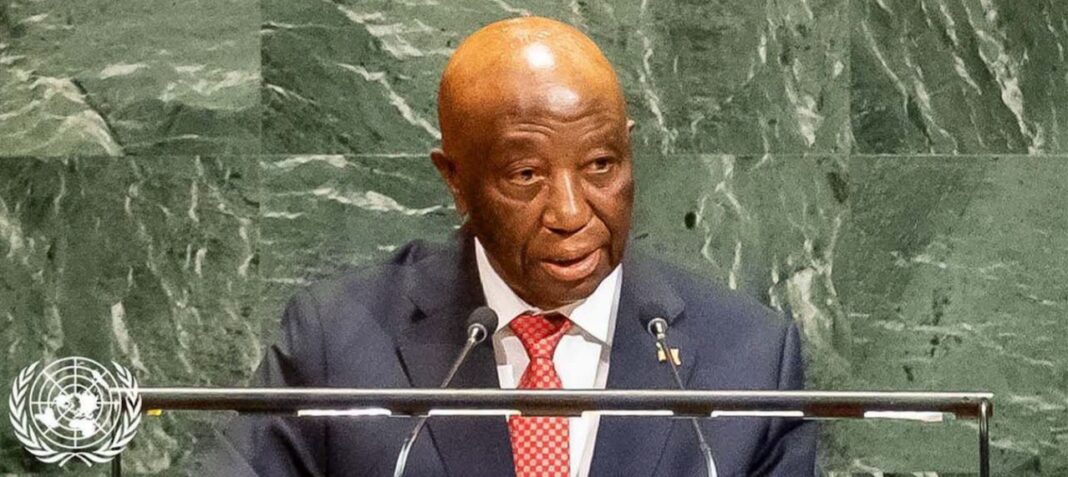
Perhaps the most striking development came on September 24, when President Boakai addressed the 81st United Nations General Assembly.
His speech was devoted extensively to international peace and security. He spoke about preventive diplomacy, mediation, early warning, West African security and Liberia’s role as a member of the UN Security Council. He even argued that preventing conflicts is preferable to dealing with their consequences after they erupt.
Yet Sorlumba and the Liberia-Guinea border dispute were not specifically mentioned in the published address.
That omission is difficult to overlook.
How does a Liberian president stand before the international community and speak about preventive diplomacy and the need to protect international peace while saying nothing about a border dispute involving Liberia itself?
The omission does not establish that the government has abandoned Sorlumba. The administration can point to its diplomatic engagements, including the Conakry summit and its stated commitment to maintaining security along the border.
But it does raise a legitimate question about national priorities and international advocacy.
Why Was Sorlumba Not Put Before the World?
Liberia had an opportunity at the United Nations to put its concerns on the international record.
President Boakai could have told the world that Liberia was committed to resolving the dispute peacefully while insisting upon respect for its territorial integrity.
He could have requested greater international support for technical border demarcation.
He could have highlighted the vulnerability of communities living along Liberia’s frontiers.
He could have explained how Liberia was applying the very principle of preventive diplomacy he promoted in his speech.
Instead, the published speech focused on a broad range of international issues—from reform of the international financial system and climate financing to UN Security Council reform and transnational crime—without specifically addressing the Sorlumba dispute.
For Liberians living near the border, that omission may understandably feel significant.
Diplomacy Must Produce Results
The government’s argument that the situation is “peaceful, calm and stable” cannot by itself settle the larger question.
In August, Information Minister Jerolinmek Piah said tensions had arisen over the location of checkpoints and that diplomatic redress was being pursued.
But peace at a border crossing is not the same thing as a permanently settled boundary.
Recent reporting has described Sorlumba as a fragile peace covering an unresolved dispute, with calls for clearer demarcation and permanent mechanisms to prevent further confrontations.
That is precisely why Liberia needs a transparent national strategy.
The government should tell Liberians:
Where exactly is Liberia’s boundary at Sorlumba?
What maps and historical agreements establish that boundary?
What territory does Liberia say has been affected by the dispute?
What diplomatic assurances has Guinea provided?
What has the joint technical process accomplished?
And when will the boundary be permanently demarcated and protected?
The Sorlumba Test
President Boakai should not be judged by whether he chooses confrontation over diplomacy. The Constitution and Liberia’s national interest do not require recklessness.
They require protection of the Republic.
Diplomacy is appropriate. Dialogue is necessary. Regional cooperation is important.
But diplomacy must ultimately protect Liberia’s territorial integrity rather than merely manage recurring confrontations.
Sorlumba therefore presents President Boakai with a defining test: Can his administration convert diplomatic meetings and communiqués into a clearly documented, permanently respected Liberian border?
And after failing to put the issue before the world’s most important diplomatic forum during his UNGA address, the administration owes the Liberian people an explanation of why a matter touching directly on the country’s territorial integrity was absent.
For Liberia, the issue is bigger than Sorlumba.
It is about whether a country that emerged from war understands that peace without clearly defended borders can remain fragile—and that sovereignty must be protected not only in speeches, but on the ground, at the negotiating table and before the international community.