MONROVIA, LIBERIA — President Joseph Nyuma Boakai’s five-year development agenda is now in a race against time.
A recent assessment by NAYMOTE warns that Liberia may struggle to meet the government’s targets for 2029 unless there is a significant acceleration in implementation.
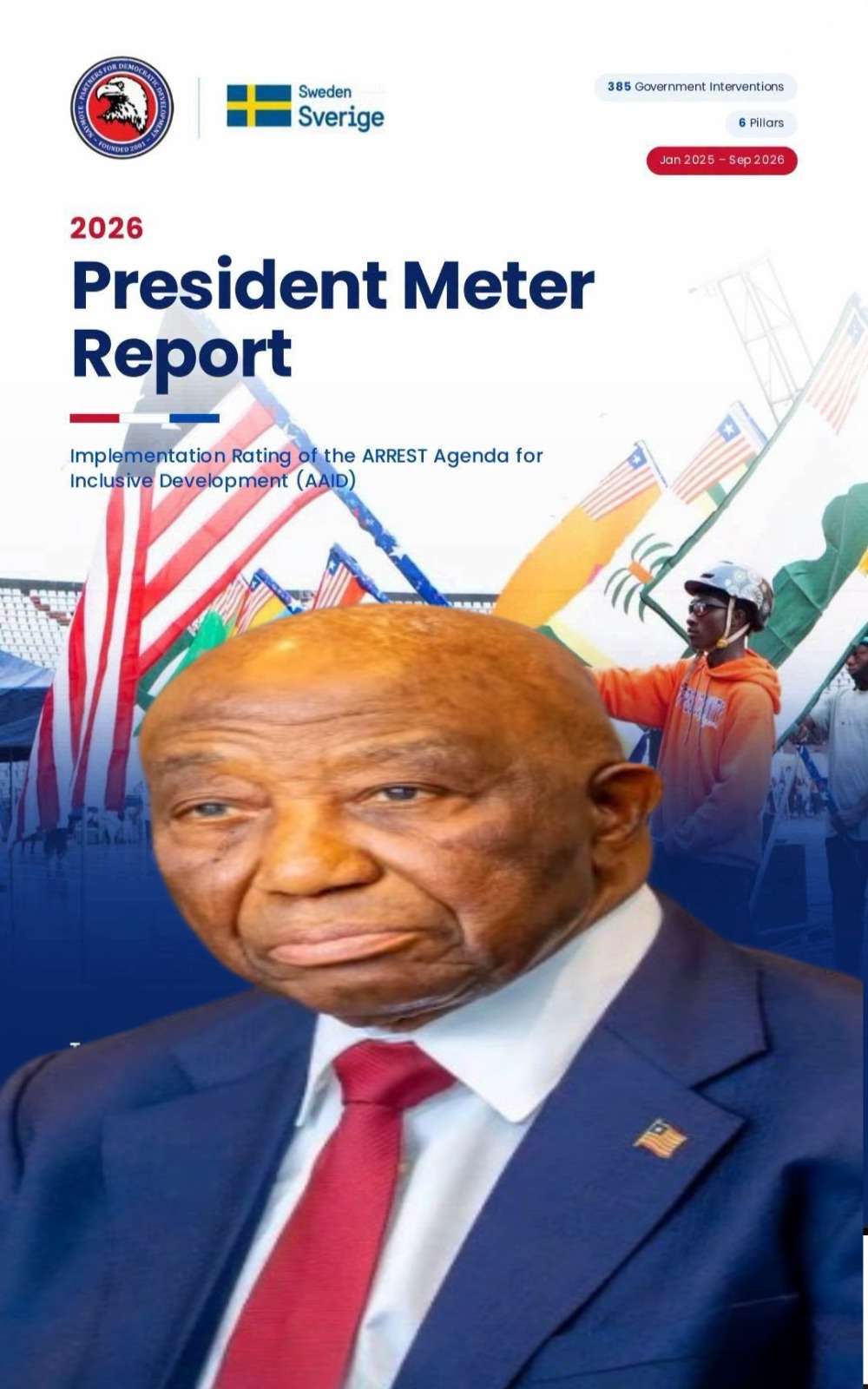
This warning comes from NAYMOTE’s latest President Meter Report 2025, which serves as its first independent evaluation of the ARREST Agenda for Inclusive Development (AAID).
It’s important to note that this report does not evaluate Boakai’s first year in office, as he assumed the presidency in January 2024, while the AAID—the government’s formal national development plan for 2025–2029—was launched in January 2025.
NAYMOTE assessed the first year of the AAID, covering the period from January to December 2025, and tracked 378 interventions across 52 core programs and six strategic pillars.
The findings raise a concerning question: With only four years left in the AAID period, can the administration act swiftly enough to transform its ambitious development plan into tangible results?
A Government Still Too Far From Its People
Perhaps the most alarming finding is not just the number of projects completed, but the ongoing challenges Liberians face in accessing government services outside of Monrovia.
NAYMOTE’s assessment of County Service Centers in Margibi, Bong, and Grand Bassa counties revealed that 60.7 percent of the 28 services evaluated were completely unavailable at the county level.
Even more concerning, 85.7 percent of these services required citizens to submit their requests in person in Monrovia.
Additionally, the study found that 75 percent of the services needed a live signature from a minister or director, and 67.9 percent required approvals from multiple agencies.
More than 60 percent of the services reportedly took 30 days or longer to process.
For an administration that promises inclusive growth and stronger local governance, these findings highlight a persistent issue: for many Liberians, government services are still largely centralized in the capital.
A citizen in the counties may have to travel to Monrovia, incur transportation and accommodation costs, navigate through various bureaucracies, and wait for signatures from officials located hundreds of miles away.
In this regard, decentralization appears to be more of a goal than a reality.
Only Three Completed
The broader assessment from the President Meter highlights ongoing concerns.
Out of the 378 AAID interventions tracked in 2025, NAYMOTE found that only three were fully completed, which is just 0.8 percent.
Additionally, 165 interventions, or 43.7 percent, were still in progress, while 76, accounting for 20.1 percent, had yet to begin.
Notably, 134 interventions—35.4 percent—could not be evaluated due to a lack of sufficient information to ascertain their status.
These numbers do not imply that the government achieved little in 2025.
NAYMOTE reported advancements in various sectors, including digital governance, infrastructure, agriculture, anti-corruption efforts, and institutional reform.
Howbeit, the report indicates that the administration’s challenge has shifted from merely establishing priorities to effectively translating plans into large-scale implementation—and doing so swiftly.
The 2029 Clock Is Ticking
The AAID is a national development plan set to span five years, from 2025 to 2029. This timeline leaves the government with just four years after the assessment period conducted by NAYMOTE.
This is where NAYMOTE’s caution becomes especially important. The organization points out that the pace of implementation observed in the first year is not adequate to meet the ambitious goals outlined in the AAID.
Consequently, the government is faced with a tough decision: either speed up implementation, enhance coordination, and improve public reporting, or risk entering the final years of the AAID with numerous commitments left unfulfilled.
NAYMOTE is advocating for a more robust coordination mechanism, which includes establishing a dedicated AAID Coordination Secretariat, requiring mandatory quarterly reports from ministries and agencies, expediting high-impact projects, and promoting stronger decentralization.
Beyond Monrovia
The NAYMOTE findings from the county service may turn out to be the most significant aspect of the report, as they connect national development policies to the everyday lives of regular Liberians.
The AAID aims to create a more inclusive Liberia. However, if citizens still need to travel to Monrovia to obtain basic government services, the gap between the government’s development strategy and the actual experiences of the people remains substantial.
NAYMOTE’s evaluation effectively highlights this issue on the national stage.
The focus is no longer just on whether the Boakai administration has a development strategy—it does.
The real question is whether the government can implement that strategy swiftly enough and extend its reach beyond Monrovia to ensure that the AAID has a real impact on the lives of ordinary Liberians before 2029.
A Test of the Boakai Presidency
President Boakai still has time ahead of him. The AAID has just wrapped up its first year, and the administration has four more years to go within the formal implementation window of the plan.
However, NAYMOTE’s report clearly indicates that the next phase must not mirror the first.
The government needs to shift from mere planning to actual execution, from making announcements to achieving measurable outcomes, and from centralized service delivery to true decentralization.
Ultimately, the administration’s success will not be measured by the quantity of policy documents it produces or programs it initiates.
Instead, it will be evaluated based on whether Liberians can truly see and feel the impact.
For President Boakai, 2029 might seem far off, but NAYMOTE’s assessment implies that the race has already started—and Liberia cannot afford to lag behind.