
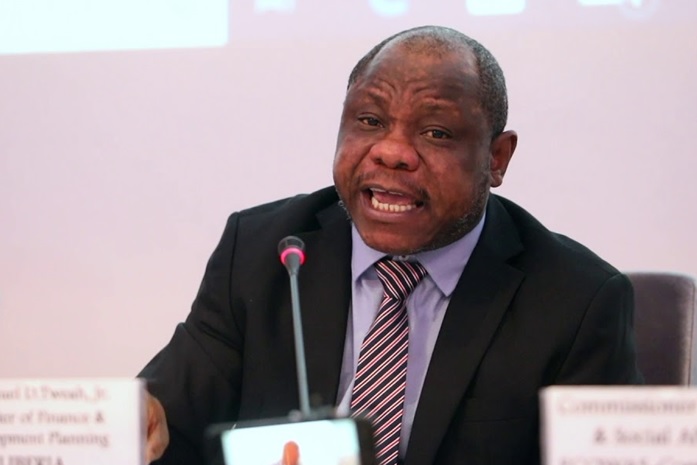
MONROVIA – Former Finance and Development Planning Minister Samuel D. Tweah has issued a strong challenge. In a direct message to current Finance Minister Augustine Kpehe Ngafuan, Tweah is demanding one thing, credit where credit is due. As the Boakai administration marches toward the implementation of Value Added Tax on January 1, 2027, Tweah insists the foundation was laid not by the so called Rescue Government, but by the George Manneh Weah led CDC administration.
Tweah’s warning was blunt. “Do not pretend that it was your Rescue Government that initiated VAT. Give due credit. Whenever you do otherwise, we will publicly respond.” It was not a suggestion. It was a challenge. And in Liberia’s increasingly polarized political climate, it was a declaration that history will not be quietly rewritten.
The timing of Tweah’s response was no accident. On February 20, 2026, Ngafuan officially launched Liberia’s nationwide VAT awareness campaign, praising the Liberia Revenue Authority for record-breaking revenue performance and outlining an ambitious roadmap toward fiscal modernization. The VAT regime, he affirmed, will take effect on January 1, 2027. The tone was triumphant. The messaging was forward looking. But for Tweah, something critical was missing, acknowledgment.
Tweah anchored his argument not in rhetoric alone but in documented history. He pointed to a January 13, 2022 communication issued under his tenure as Finance Minister. In that official statement, the Government of Liberia announced additional stakeholder engagement toward transitioning from GST to VAT. The roadmap, the consultations, the white papers, and the draft legislation were all initiated under the CDC government.
The record is clear. Under Weah’s leadership, Liberia began structured consultations, prepared draft VAT legislation, developed a migration plan, and engaged partners including USAID and the World Bank. The groundwork was laid for a tax reform designed to broaden the revenue base, enhance transparency, and align Liberia with regional standards under Economic Community of West African States.
Liberia, at the time, stood as the only country in the sub-region not VAT compliant or on a firm compliance path. The Weah administration made the strategic decision to correct that anomaly. It was not a cosmetic reform. It was a structural fiscal transformation intended to modernize revenue generation and reduce reliance on volatile external support.
Tweah’s 2022 letter detailed the economic rationale. VAT, he argued, would generate significantly more revenue than GST, potentially raising about 6% of GDP compared to less than 3% under the existing regime. It would neutralize distortions, make exports more competitive, and reduce incentives for smuggling and undervaluation. In short, VAT was framed as a growth instrument, not merely a tax adjustment.
Critically, the CDC government emphasized that VAT would not impose additional burdens on consumers. Essential goods and services such as agricultural products, medical services, medicines, and educational services were to be exempt. Small businesses below a defined threshold would be excluded from VAT formalities altogether. The reform was presented as progressive, structured, and socially conscious.
Preparatory work had already begun. Draft laws were prepared. A VAT White Paper was developed. A migration plan was designed. Capacity-building programs were envisioned. IT systems upgrades were anticipated. Public education campaigns were outlined. The transition timeline was projected to take three to four years. That clock, Tweah suggests, started ticking long before the Rescue Government took office.
Ngafuan, however, is projecting confidence in his administration’s stewardship of the process. He highlights record revenues in 2024 and 2025, anticipates crossing the billion-dollar threshold, and points to an $18 million Domestic Resource Mobilization Project supported by the African Development Bank. His message is clear that this government is delivering results and strengthening fiscal resilience.
But Tweah’s counterpoint cuts deeper than numbers. It is about narrative ownership. He is not disputing the current administration’s role in implementation. He is disputing any suggestion that VAT was conceived, initiated, or strategically designed by them. “When we say you guys are playing in our foundation you all become upset,” he wrote. The metaphor is telling. The structure may be rising now, but the concrete was poured years ago.
This confrontation is more than political sparring. It speaks to a broader Liberian pattern where administrations are eager to erase their predecessors rather than build honestly upon them. National progress becomes a partisan trophy rather than a shared continuum. That mindset undermines institutional memory and distorts public understanding.
If Ngafuan is serious about national discourse, then acknowledgment costs nothing. Recognizing that VAT reform began under the Weah administration does not diminish current efforts. It strengthens credibility. Transparency about policy continuity fosters trust. Silence invites confrontation.
Tweah has made it clear that he will not allow silence. He has placed the historical record squarely on the table. The question now is whether the Rescue Government will embrace honesty or continue crafting a narrative that omits inconvenient facts.
VAT may officially take effect on January 1, 2027. But the battle over who birthed it has already begun. And in this contest of political memory, Tweah is signaling that the CDC will not sit quietly while others claim authorship of what they insist was their reform.