By Staff Writer | Smart News Liberia
SINKOR, MONROVIA – Liberia’s Minister of Justice and Attorney General N. Oswald Tweh has warned that the growing link between terrorism and transnational organized crime represents one of the most serious security threats facing West Africa, urging stronger institutional coordination and legal preparedness to prevent instability.
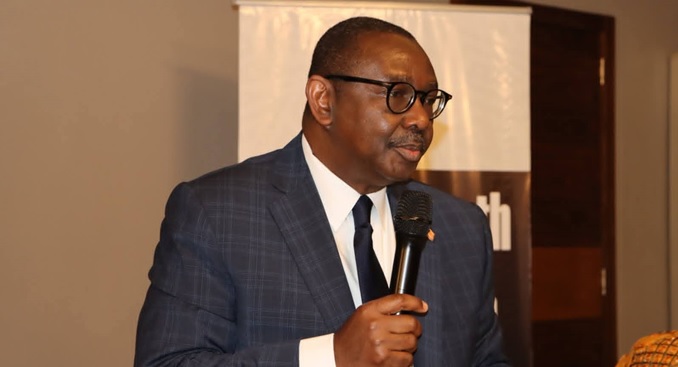
Tweh made the remarks on Wednesday during the opening of a United Nations Office on Drugs and Crime (UNODC) workshop for prosecutors and law enforcement officers held at the Corina Hotel in Sinkor, where he delivered a special opening statement as Acting Chair of Cabinet.
Addressing diplomats, security officials, and international partners, Tweh said modern threats are no longer isolated but interconnected, evolving in ways that make them harder to detect and more dangerous to contain.
“The threats confronting nations today are no longer isolated or easily identifiable. They evolve rapidly, adapt strategically, and often operate quietly beneath the surface of ordinary society,” Tweh cautioned.
He stressed that insecurity often develops gradually through weak institutions, corruption, porous borders, poor coordination, and public complacency before escalating into full-scale national crises.
According to him, terrorism and organized crime were once treated as separate phenomena, but that distinction has now collapsed as extremist groups increasingly depend on criminal networks for financing and logistics.
“These violent extremist groups now rely heavily on criminal enterprises to finance and sustain their operations,” Tweh explained, noting that trafficking networks, illegal mining, money laundering, drug trade, and cybercrime have become central to their operations.
He warned that the convergence of these criminal activities creates a dangerous cycle where insecurity fuels crime and crime, in turn, deepens instability across the sub-region.
Tweh emphasized that Liberia fully understands the urgency of these emerging threats, citing the country’s own history as a reminder that instability often begins quietly through institutional weaknesses and unchecked vulnerabilities.
“Our nation’s history reminds us that instability rarely begins with dramatic events. It grows through weakened institutions, inadequate coordination, and the erosion of public confidence,” he stated.
The Justice Minister stressed that no single institution can effectively respond to modern security threats, calling for deeper cooperation among intelligence services, law enforcement, prosecutors, immigration authorities, customs officials, and the judiciary.
He warned that without coordination and information sharing, criminal and extremist networks will continue to exploit institutional gaps faster than governments can respond.
“Without legal preparedness and technical capacity, criminal networks and extremist actors will continue to exploit institutional gaps,” Tweh cautioned, describing inter-agency collaboration as “essential, not optional.”
The workshop, organized under a UNODC-supported initiative, brought together criminal justice actors to strengthen investigation, prosecution, and coordination mechanisms across Liberia and the West African region.
Tweh commended the UNODC and its partners for supporting Liberia’s justice system through training, dialogue, and capacity-building programs aimed at improving institutional effectiveness and regional cooperation.
At the same time, he cautioned that efforts to strengthen security must remain firmly grounded in the rule of law, transparency, accountability, and respect for human rights.
“The strength of a democratic state is measured not only by its ability to confront threats, but also by its ability to do so without compromising justice and constitutional order,” he said.
The Minister concluded by urging sustained collaboration among institutions, stressing that effective crisis response depends on preparation, not reaction, and on building trust long before emergencies arise.