MONROVIA, LIBERIA – Justice Minister and Attorney General Cllr. N. Oswald Tweh has warned that Liberia cannot defeat the country’s growing drug crisis by abandoning the very rule of law it is seeking to defend, insisting that every major narcotics case must be built on credible evidence and determined through due process.
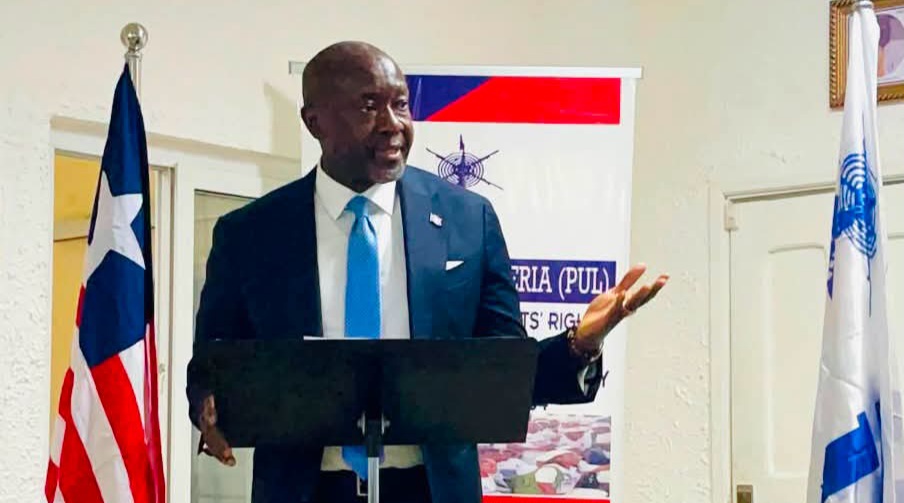
Tweh delivered the warning Wednesday, August 26, 2026, during the Press Union of Liberia’s relaunch of the Edward Wilmot Blyden Intellectual Discourse in Monrovia, where he joined lawmakers, civil society leaders, legal professionals and media practitioners for a high-level discussion on drug trafficking and the future of Liberia’s institutions.
His intervention presented a different dimension of the government’s drug campaign, focusing not only on the unprecedented volume of narcotics seized but also on the legal standards that must govern what happens after the cameras leave the seizure sites.
Tweh said Liberia has reached a critical moment in its fight against drug trafficking.
The country has recorded major narcotics seizures, including approximately 237 kilograms of cocaine intercepted at Roberts International Airport and nearly four tons of cocaine discovered in Duazon, Margibi County.
Authorities subsequently destroyed more than US$336 million worth of seized narcotics in July.
But the Justice Minister cautioned that such dramatic enforcement actions cannot by themselves establish guilt.
The ultimate test, he said, is whether investigators can convert seizures into admissible evidence and whether prosecutors can present cases strong enough to withstand judicial scrutiny.
“At the Ministry of Justice, our responsibility is to ensure that seizures are followed by investigations; that investigations are followed by evidence; and that evidence is presented before the courts,” Tweh said.
That position places the legal process at the center of the government’s response and comes as public debate intensifies over allegations surrounding the narcotics investigation.
Tweh made clear that the government intends to pursue evidence wherever it leads.
He said drug enforcement cannot stop with individuals occupying the lowest levels of trafficking operations.
Accountability, he argued, must reach financiers, facilitators and anyone else whose involvement can be established through credible evidence.
“If the evidence leads to a customs officer, a security officer, a businessman, a politician or any other person, the law must be allowed to take its course,” he said.
The statement represents a broad pledge that the government will not restrict its investigation based on rank, occupation or political influence.
But Tweh paired that pledge with an equally strong warning against convicting people through public accusations.
He said popularity on radio, repeated allegations on social media or political convenience cannot replace evidence.
“At the same time, no person should be convicted because his or her name is popular on the radio, circulating on social media or politically convenient to accuse,” he said.
“That is not justice.”
The Attorney General’s position underscores the difficult balance facing the government as it investigates a drug-trafficking network believed to involve multiple layers of activity.
Authorities face pressure to demonstrate that the state is taking decisive action, while prosecutors must ensure that cases are prepared according to legal standards.
Tweh argued that these objectives are not contradictory.
Instead, he said, credible enforcement requires both determination and restraint.
“The Government will not fight lawlessness by abandoning the law,” he declared.
He also defended the government’s record against accusations that it has failed to confront the narcotics crisis.
Tweh pointed to the scale of the recent seizures and arrests, saying the administration’s actions constitute tangible evidence of an active campaign.
He noted that in the first quarter of the year, the LDEA seized more than 400 kilograms of illegal narcotics and arrested more than 200 suspects.
He also cited the subsequent cocaine seizure at Roberts International Airport and the much larger Duazon operation.
For Tweh, these developments represent a level of enforcement that cannot fairly be dismissed as government inaction.
“The fight against drugs cannot be measured by propaganda,” he said.
But the Attorney General also acknowledged that major seizures expose vulnerabilities in the country’s security architecture.
A shipment reaching its eventual destination, he said, raises questions about the chain through which it passed.
“If narcotics can move through a chain of handling, screening or transportation, then that chain must be examined and strengthened,” Tweh said.
He called for authorities to identify weaknesses, investigate potential facilitation or corruption, improve intelligence gathering and strengthen coordination among security agencies.
The goal, he said, should be to dismantle criminal networks rather than merely disrupt individual shipments.
Tweh’s remarks also placed the Liberian media at the center of the accountability debate.
He praised journalists for keeping drug trafficking in the public conversation and acknowledged the media’s role in questioning government officials and reporting major seizures.
But he cautioned that the urgency of the crisis makes responsible reporting even more important.
“Information must enlighten and not inflame; facts must be distinguished from speculation,” he said.
He said journalists have a duty to ask difficult questions, while government has a corresponding duty to provide answers and accept scrutiny.
For Tweh, a free press and an accountable government should not be competing forces.
They should reinforce one another.
His comments came as Liberia’s drug crisis has generated intense political debate and public suspicion, particularly surrounding allegations involving security officials and other individuals.
Tweh said the government would not be deterred by political criticism but would also not use the drug investigation as a weapon against political opponents.
He rejected what he characterized as efforts to portray every government action through a narrow political lens.
Some critics, he argued, demanded action but dismissed the government’s response once action was taken.
“We welcome criticism, but criticism must not become blindness,” Tweh said.
Yet his strongest defense of the government’s approach was grounded in the rule of law.
He said the government must be strong enough to prosecute genuine wrongdoing but disciplined enough to protect innocent people from arbitrary accusations.
That distinction, he argued, is fundamental to the credibility of the drug investigation.
The rule of law, he said, gives the state the authority to investigate and prosecute but also protects defendants, journalists and citizens.
“If we weaken due process in the name of fighting drugs, we weaken the very Republic we claim to defend,” Tweh warned.
The Attorney General further argued that the government’s campaign should not be judged solely by the number of arrests or the quantity of drugs destroyed.
A successful drug strategy, he said, must strengthen institutions so they can detect, investigate and correct failures.
He described strong institutions as those capable of recognizing weaknesses rather than pretending they do not exist.
That principle, he said, must guide the response to every major narcotics seizure.
The government must determine how drugs entered Liberia, how they moved through the country, whether officials or private actors facilitated their movement and what weaknesses allowed the networks to operate.
Tweh said the Ministry of Justice would continue working with the LDEA, Liberia National Police and other security institutions to ensure that investigations are followed by prosecutions grounded in evidence.
He also said the government would continue accepting legitimate scrutiny from the media and civil society.
But he maintained that criticism should not replace facts and that allegations should not be mistaken for convictions.
The Justice Minister concluded by invoking Blyden’s legacy and the responsibility of Liberians to build institutions capable of defending the country’s future.
He said narcotics threaten not only public safety but families, communities, institutions and the state’s capacity to govern.
The response, he argued, must therefore be national, sustained and anchored in law.
“We did not choose this threat,” Tweh said. “But we must choose our response.”