An Investigative Look at the Possible Protocol and Security Breakdown Surrounding VP Koung
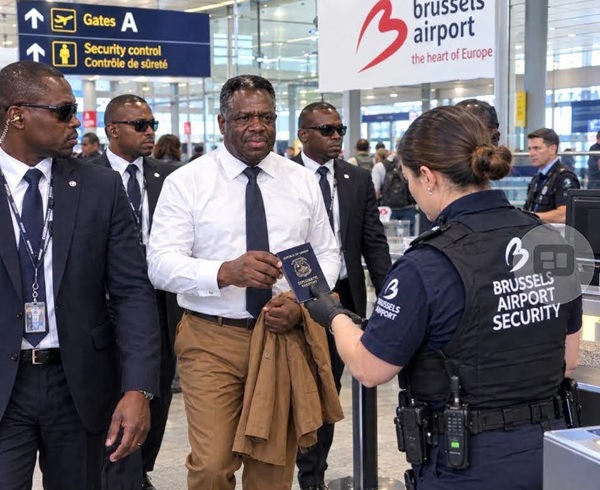
MONROVIA, LIBERIA — The controversy surrounding Vice President Jeremiah Kpan Koung at Brussels Airport may be about more than whether he was asked to remove an item of clothing during security screening.
At the center of the developing story is a more important question:
How did Liberia’s Vice President, while traveling as part of an official delegation, end up using the ordinary passenger route at a major European airport—and was that movement consistent with the security and protocol arrangements for his visit?
Koung himself appears to have provided the key piece of information.
Explaining the incident, he said he deliberately chose the regular route used by ordinary passengers because he wanted to purchase a few things for his daughter from Duty Free.
“This trip, I chose to use the regular route that everyone uses to pick up a few things for my daughter from the Duty Free stores, and again there are discussions.”
He also said: “No shoes, no jacket was removed.”
That statement may settle one part of the controversy, but it opens another.
THE PROTOCOL QUESTION
Belgium’s Federal Public Service Foreign Affairs has a formal system governing visits by foreign dignitaries. Its Protocol Directorate says foreign VIP visits are to be notified in advance, with information used to determine the appropriate reception and security measures.
Belgium also maintains VIP facilities at Brussels National Airport for qualifying senior officials. Its protocol guidance states that access to VIP facilities depends on the nature of the visit and that, for certain official visits, reception is organized through Belgian authorities.
Belgian authorities also state that their Protocol Directorate serves as an entry point for senior officials and the organization of protection, with escort and close-protection services potentially available depending on circumstances and threat levels.
None of this proves that Koung violated a specific protocol rule.
But it raises a legitimate investigative question:
If arrangements had been made for the Vice President’s official movement, why did he choose to enter the ordinary passenger flow for personal shopping?
WAS THE SECURITY DETAIL INFORMED?
This is perhaps the most important unanswered question.
A senior official does not normally move through an international airport in exactly the same way as an ordinary passenger when security and protocol arrangements have been established.
If Koung decided independently to leave the official movement arrangement, several questions follow.
Was his security detail informed?
Did the head of his protection team approve the decision?
Was the Liberian Embassy informed?
Did Belgian protocol officials know about the change?
Was the Vice President accompanied by his full security detail while using the regular passenger route?
And did the change expose the delegation to a security vulnerability that had not been included in the original movement plan?
Those questions cannot responsibly be answered without statements from the Liberian security team, the delegation or Belgian authorities.
THE DUTY-FREE EXPLANATION
The unusual element is that the deviation, according to Koung’s own account, was apparently not prompted by an emergency or official necessity.
It was to buy items for his daughter.
There is nothing inherently improper about purchasing personal items while traveling.
But the investigative issue is whether personal convenience should have required a sitting Vice President to depart from established security arrangements while representing Liberia abroad.
The distinction matters.
An ordinary passenger can decide to change direction at an airport without creating a national-security question.
A Vice President cannot necessarily make the same calculation without considering the implications for his protective detail, diplomatic coordination and the official delegation.
WAS LIBERIA EMBARRASSED—or WAS THE INCIDENT MISUNDERSTOOD?
Reports circulating on social media have described the incident in dramatic terms, including claims that Koung was subjected to an unusually intrusive search.
Those claims remain disputed.
Koung has specifically denied that his shoes or jacket were removed.
Therefore, an investigative account should not repeat the more sensational versions as established fact.
What can be established is that the episode generated enough controversy for the Vice President himself to respond.
That makes the management of the situation relevant to Liberia’s international image.
Belgium’s protocol system is designed precisely to coordinate the reception, movement and security of foreign dignitaries.
If Liberia’s Vice President voluntarily moved outside that arrangement, the government should explain whether the decision was coordinated.
If it was coordinated, who authorized it?
If it was not coordinated, why was the Vice President permitted to leave the established movement plan?
And if the ordinary passenger route resulted in additional screening, was that simply the predictable consequence of entering the normal airport system?
THE BIGGER QUESTION FOR LIBERIA
The Brussels episode should not become a political argument over whether Koung was “disrespected” by Belgian airport personnel.
International airports operate security procedures, and foreign dignitaries are not necessarily exempt from every form of aviation security screening.
The more consequential issue is whether Liberia’s own planning and decision-making contributed to the situation.
If a VIP security arrangement existed and was bypassed for personal shopping, then the government has a responsibility to explain why.
If no special arrangement existed, Liberians deserve to know why the Vice President’s official travel was not coordinated accordingly.
And if the movement was fully authorized and consistent with protocol, then that should also be stated clearly.
AN INVESTIGATIVE JOURNALIST’S QUESTIONS
From an investigative standpoint, the answers should come from documents and officials—not social-media speculation.
The questions are straightforward:
What was the official itinerary and airport movement plan for Vice President Koung?
Was VIP airport access arranged through Belgian protocol?
Did Koung leave the planned route to visit Duty Free?
Was his security detail informed beforehand?
Who authorized the deviation?
Was the Liberian Embassy involved?
Did Belgian protocol officials know about the change?
What exactly triggered the additional screening?
Was the screening routine or additional?
Did the incident result from a failure of coordination, a personal decision, or normal airport procedure?
Until those questions are answered, declaring that Koung breached protocol would go beyond the available evidence.
But equally, dismissing the episode as nothing more than an airport misunderstanding would overlook the central issue.
The real investigation is not simply what Belgian airport security did to Liberia’s Vice President. It is what Liberia’s own protocol and security arrangements allowed to happen before he reached that security checkpoint.
Investigative report by Liberian investigative journalist Lyndon J. Ponnie, Sr.