By Socrates Smythe Saywon | Smart News Liberia
The World Bank’s approval of approximately US$125 million in financing for Liberia is being celebrated by the administration of President Joseph Nyuma Boakai as a major step toward addressing some of the country’s most pressing infrastructure challenges. The funding package targets digital connectivity, electricity, and roads, three critical sectors that have long been identified as major obstacles to national development and economic growth.
Yet beyond the official celebrations and optimistic statements lies a question many Liberians have heard before and are once again asking: Will citizens finally see results?
For decades, successive governments have announced major financing agreements, secured international loans and grants, and unveiled ambitious development programs. Despite billions of dollars in foreign assistance and development support flowing into Liberia since the end of the civil war in 2003, many communities continue to struggle with poor roads, unreliable electricity, weak internet access, and inadequate public services.
This reality explains why the World Bank’s latest US$125 million package is being welcomed with cautious optimism rather than unquestioned enthusiasm. Liberians are increasingly less impressed by the size of financing agreements and more interested in whether those investments will produce visible improvements in their daily lives.
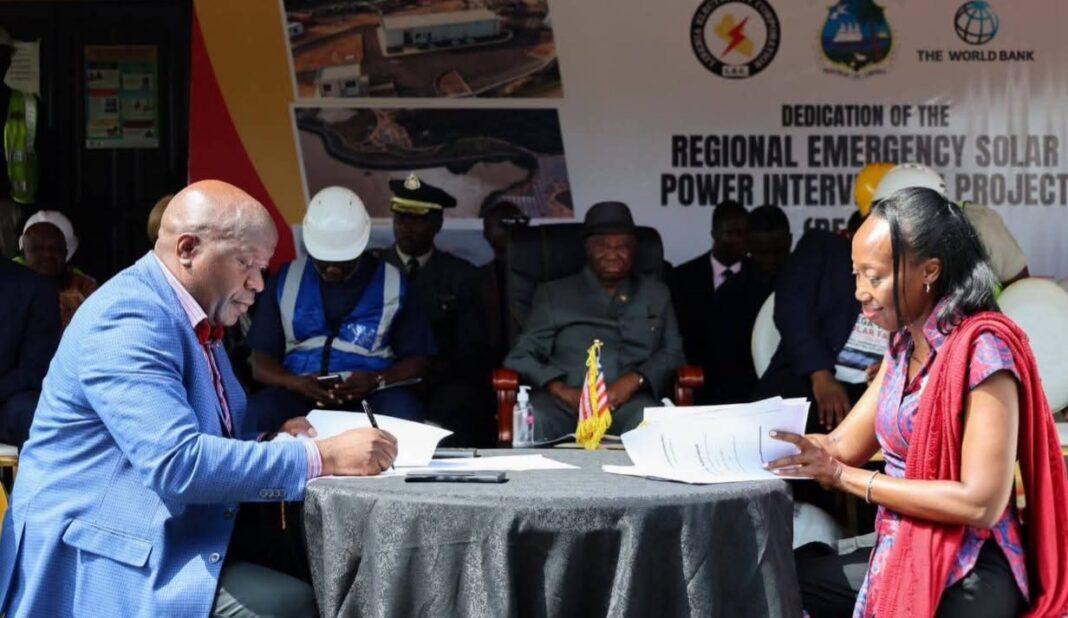
The agreements were signed on June 5, 2026, in Harrisburg, Montserrado County, and cover financing for three major initiatives: the Western Africa Regional Digital Integration Program (WARDIP 2), the Regional Emergency Solar Power Intervention Project (RESPITE) Additional Financing, and the Southeastern Corridor Road Asset Management Project (SECRAMP) Second Additional Financing.
Speaking at the signing ceremony, Finance and Development Planning Minister Augustine Kpehe Ngafuan described the occasion as a significant milestone in Liberia’s development agenda. He thanked the World Bank for its continued partnership and support and emphasized that the projects would help address some of the country’s most urgent development challenges.
The Finance Minister also paid tribute to World Bank Country Manager Georgia Wallen, whom he credited for playing an important role in helping secure financing for the three projects.
“We extend our sincere appreciation to Madam Georgia Wallen for her tireless efforts and dedication, which contributed significantly to making these projects reach this stage,” Ngafuan stated.
According to the Minister, the investments align with President Boakai’s ARREST Agenda for Inclusive Development, which seeks to create jobs, expand economic opportunities, improve infrastructure, and raise living standards across the country.
“Energy, roads, and digital connectivity are among the most important foundations for economic development. By investing in these areas, we are laying the groundwork for sustainable and inclusive growth,” Ngafuan asserted.
The government’s optimism is understandable.
Few Liberians would disagree that the country desperately needs better roads, more reliable electricity, and improved internet access. These sectors are essential for economic growth, job creation, investment, education, healthcare delivery, and national competitiveness.
However, this is precisely why citizens are justified in asking hard questions.
The challenge confronting Liberia today is no longer whether financing can be secured. The challenge is whether government institutions possess the capacity, discipline, transparency, and accountability necessary to convert financing into meaningful development outcomes.
The largest share of the package, US$57 million, has been allocated to the RESPITE Project to strengthen Liberia’s energy sector. The financing will support improvements at the Mount Coffee Hydropower Plant, expansion of the country’s solar park from 20 megawatts to 30 megawatts, and deployment of battery storage systems intended to reduce outages and improve electricity reliability.
According to Ngafuan, the investment will help increase access to affordable electricity, support businesses, and improve the lives of thousands of Liberian families.
Those objectives are certainly commendable.
Yet they also expose one of Liberia’s most persistent development frustrations. Successive governments and international partners have invested heavily in the energy sector over the years. Despite these efforts, electricity remains inaccessible, unreliable, or unaffordable for many households and businesses.
This reality raises an uncomfortable but necessary question: What specific safeguards are in place to ensure that this latest investment succeeds where previous efforts have struggled?
The same scrutiny should apply to the US$50 million allocated for WARDIP 2.
The initiative aims to expand broadband access, strengthen cybersecurity, improve digital governance, promote innovation and entrepreneurship, and support e-commerce and digital payment systems throughout Liberia.
Government officials argue that the project will help bridge Liberia’s digital divide while creating new opportunities for young people and businesses to participate in the digital economy.
The vision is compelling.
In today’s global economy, countries that fail to invest in digital infrastructure risk being left behind. Reliable internet access has become as important to development as roads and electricity.
Yet the success of this investment cannot be measured by government announcements or policy documents. It will ultimately be judged by whether internet access becomes more affordable, more reliable, and more accessible to communities that have historically been excluded from the digital revolution.
The third component of the financing package provides US$18 million in additional support for SECRAMP, which seeks to advance road works along the strategic Ganta-Tappita corridor and strengthen transportation links in southeastern Liberia.
The government believes the project will reduce travel times, lower transportation costs, facilitate trade, and improve access to markets, schools, and healthcare facilities.
For residents of southeastern Liberia, these promises carry enormous significance.
For years, inadequate road infrastructure has limited economic opportunities and isolated many communities from essential services. Better roads have the potential to stimulate commerce, improve mobility, and strengthen regional integration.
Yet road projects have also become symbols of Liberia’s long-running development disappointments.
Time and again, citizens have witnessed infrastructure projects launched with great fanfare only to become delayed by bureaucratic inefficiency, funding complications, contractual disputes, or weak oversight.
This history explains why many Liberians remain cautiously optimistic rather than fully convinced.
For her part, World Bank Country Manager Georgia Wallen reaffirmed the institution’s commitment to supporting Liberia’s development priorities.
“These investments are designed to improve lives, strengthen economic resilience, and create opportunities for Liberians,” Wallen emphasized.
Her statement reflects the promise behind the US$125 million package.
Indeed, few would question the potential benefits of expanding electricity access, improving internet connectivity, and upgrading road infrastructure. These investments could significantly improve living conditions, support economic growth, and create opportunities for thousands of Liberians.
But potential alone does not build roads.
Potential alone does not keep the lights on.
Potential alone does not connect rural communities to the internet.
Only effective implementation can accomplish those goals.
This is where the Boakai administration faces its greatest test.
President Boakai campaigned on promises of competence, accountability, and a break from the governance failures that have frustrated Liberians for years. Those promises raised expectations among citizens who are increasingly demanding measurable results rather than political rhetoric.
When international partners commit substantial resources to Liberia, citizens expect transparency. They expect regular updates. They expect audits. They expect accountability for every dollar spent.
Most importantly, they expect outcomes.
The World Bank’s willingness to continue investing in Liberia reflects confidence in the country’s potential and future prospects. However, confidence from development partners should never be mistaken for proof of success.
Success will not be measured by the signing ceremony in Harrisburg.
Success will not be measured by press releases or government statements.
Success will be measured by whether families gain reliable electricity, whether students and entrepreneurs gain affordable internet access, and whether travelers can safely and efficiently move along roads that have long been neglected.
The true test of this US$125 million package therefore begins now.
If the projects are implemented efficiently, transparently, and on schedule, they could become one of the most significant infrastructure achievements of the Boakai administration.
But if the financing follows the familiar path of delays, weak oversight, and unrealized promises, it will simply become another example of development opportunities that failed to transform the lives of ordinary Liberians.
Liberia does not merely need more financing.
Liberia needs proof that financing can be translated into tangible benefits for its citizens.
The World Bank has provided the resources. The responsibility for delivering results now rests squarely with the Boakai administration.