MONROVIA, LIBERIA – President Joseph Boakai has delivered one of his strongest defenses yet regarding the government’s ongoing fight against illegal drugs, asserting that his administration will uphold Liberia’s laws “without fear or favor.”
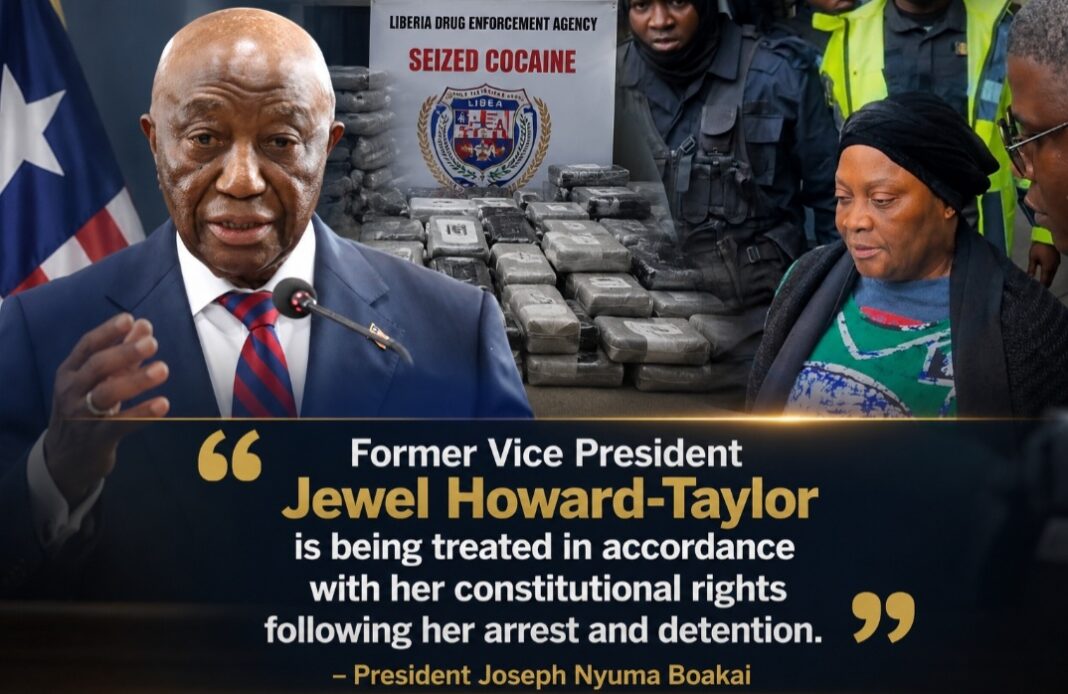
He emphasized that former Vice President Jewel Howard-Taylor is being treated in accordance with her constitutional rights following her arrest and detention.
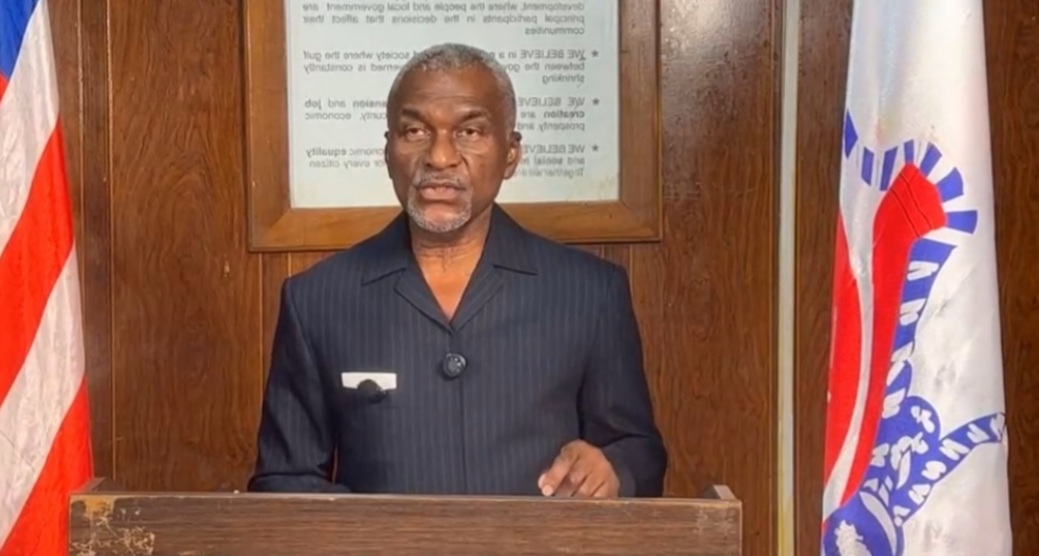
In a special address to the nation Wednesday evening, President Boakai aimed to ease the growing public anxiety surrounding Howard-Taylor’s arrest, acknowledging that recent events have sparked widespread discussion, concern, and, at times, misinformation.
“I come to you this evening to reaffirm a solemn commitment: this Administration will enforce the law without fear or favor while protecting the constitutional rights of every person,” Boakai stated.
The President made it clear that the executive branch won’t be the one to decide whether Howard-Taylor is guilty or innocent, emphasizing that this responsibility lies with Liberia’s justice system.
“It’s not the President’s job to determine guilt or innocence. That duty belongs to our independent justice system,” he stated.
Boakai also spoke directly about the former Vice President’s situation, recognizing the significant national and international attention her arrest and detention have garnered.
“I want to assure every Liberian, our regional neighbors, and our international partners that former Vice President Taylor is being treated in full accordance with the Constitution and laws of Liberia,” he affirmed.
Boakai mentioned that Taylor has access to legal representation and is entitled to due process, saying, “She is presumed innocent, has access to legal counsel, and is entitled to due process, which will be respected.”
The President noted that Taylor was arrested and charged following established legal procedures, making it clear that his office is not involved in determining her guilt.
His comments seemed to be a response to claims that the former Vice President’s arrest might be politically charged, especially considering her past role as Liberia’s second-highest elected official and her ties to the opposition.
Boakai firmly dismissed that notion, indicating, “This national campaign against drugs and organized crime isn’t aimed at any one person, party, or political group; it’s focused on behaviors that jeopardize the safety, stability, and future of Liberia.”
The President linked the Howard-Taylor case to what he called a larger national effort against drug trafficking, money laundering, and organized crime.
He emphasized that Liberia is facing an escalating threat from illegal drugs and cautioned that the repercussions go well beyond just criminal activities.
“Drugs are destroying young lives, weakening families fueling violence, and threatening our country’s future,” Boakai stated.
He framed the drug crisis as not just a law enforcement issue, but a pressing national security and moral dilemma.
The President emphasized that security agencies have been directed to collaborate effectively and independently with both local and international partners to ensure that Liberia doesn’t turn into a transit hub for illegal drugs or a refuge for criminal organizations.
“This campaign is deliberate, coordinated, and unrelenting,” Boakai asserted, adding that the goal is to “defend the Liberian people, protect the Liberian character, and safeguard our nation’s future.”
Boakai didn’t hold back in sending a clear message to politicians, religious leaders, civil society groups, and public figures: any attempts to sway or intimidate those enforcing Liberia’s drug laws will not be tolerated.
He acknowledged that the public’s interest in the Taylor case is valid in a democratic society, but he firmly stated that the determination of guilt or innocence should rest solely with the courts.
“Guilt or innocence must be determined by the courts, not by politics, rumor, conjecture, or public pressure,” he emphasized.
The President also assured that his administration would not target or shield anyone based on their political ties, official roles, social standing, or influence.
“Whether someone has held a high office, served in government, led a business, or is just an everyday citizen, the law must apply equally to all,” Boakai maintained.
This declaration stood out as one of the most powerful points in his address, framing Howard-Taylor’s case within a larger argument that Liberia’s justice system must prove that even the influential are not above the law.
He highlighted the battle against narcotics as a key challenge facing his administration, emphasizing that the government’s efforts target not just drug trafficking, but also money laundering and organized crime, involving both Liberia’s security forces and international allies.
The President took a moment to commend the members of the Joint Security for their professionalism and bravery, especially in the face of what he referred to as pressure, intimidation, and “calculated misinformation.”
He urged security personnel to stay neutral while upholding the rights and dignity of the citizens they serve.
With the arrest of Howard-Taylor sparking a heated public discussion, Boakai reached out to Liberians, urging them to steer clear of any actions that might jeopardize the nation’s peace.
He called on parents, communities, schools, churches, mosques, traditional leaders, and the youth to dismiss misinformation and back the lawful reporting of criminal activities.
He also encouraged political and religious figures to practice restraint.
“Healthy debates are a part of democracy,” he stated, adding, “but we must firmly reject any words or actions that could incite violence, weaken our institutions, or intimidate those who uphold our laws.”
The President cautioned that Liberia simply cannot afford to slip back into a culture where justice is swayed by fear, political clout, or pressure.
“Liberia has made significant strides, and we cannot allow ourselves to slip back into a culture where justice is influenced by fear, power, or political pressure,” he noted.
Beyond the immediate uproar surrounding Howard-Taylor, this speech was part of a larger effort by Boakai to position his administration’s anti-drug initiative as a key aspect of his duty to safeguard Liberia and bolster its institutions.
He connected the battle against narcotics to his administration’s ARREST Agenda for Inclusive Development, emphasizing that advancements in the economy, education, infrastructure, and public institutions hinge on upholding the rule of law.
“One fundamental principle” must guide Liberia’s development, he asserted.
The President wrapped up his speech by reassuring the people of Liberia that his administration is dedicated to upholding justice, fairness, accountability, and peace.
“We will govern without fear or favor, safeguard the rights of every citizen, and create a Liberia where peace thrives, justice is fair, and accountability is upheld for everyone,” Boakai stated.
His remarks now place the next significant phase of the Howard-Taylor case firmly in the hands of Liberia’s justice system, while also putting the Boakai administration to the test: can the commitment to equal justice hold strong against the political pressures and intense public scrutiny surrounding one of the nation’s most notable former officials?