By Socrates Smythe Saywon
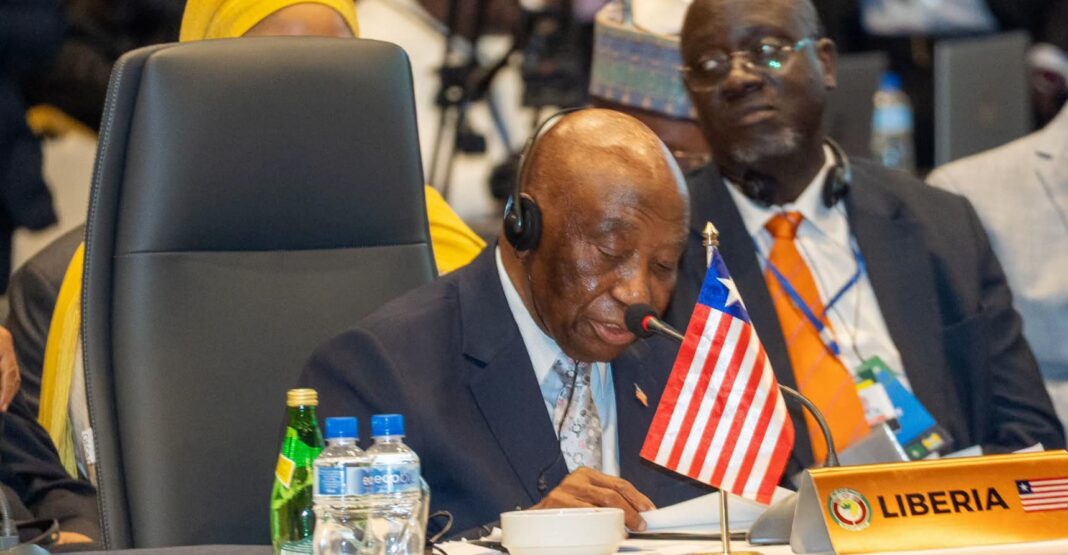
MONROVIA – President Joseph Nyuma Boakai has called for reforms within the Economic Community of West African States (ECOWAS), urging the regional bloc to move beyond summit declarations and deliver tangible economic, security, and governance benefits to millions of West Africans.
Speaking at the Summit on the Future of Regional Integration in West Africa and the 69th Ordinary Session of the ECOWAS Authority of Heads of State and Government in Lungi, Sierra Leone, on Sunday, July 19, 2026, Boakai warned that ECOWAS stands at a critical crossroads as the region grapples with escalating security threats, democratic challenges, economic pressures, climate change, and rising expectations from its youthful population.
The Liberian leader argued that regional integration must transition from political commitments to measurable action, insisting that ordinary citizens should experience the practical benefits of ECOWAS through increased trade, improved infrastructure, job creation, stronger economic resilience, and lasting peace.
“Our people must see the benefits of ECOWAS in their daily lives, not only through declarations adopted in conference halls, but through greater peace, increased trade, more employment opportunities, improved infrastructure, and stronger economic resilience,” President Boakai declared.
His remarks come as ECOWAS continues to navigate one of the most difficult periods in its history following the withdrawal of Burkina Faso, Mali, and Niger, while confronting persistent insecurity, democratic instability, economic uncertainty, and growing pressure to restore confidence in regional cooperation.
Boakai told regional leaders that Liberia fully supports the Compact for the Future of Regional Integration, emphasizing that the success of ECOWAS should be measured by concrete improvements in the lives of citizens rather than the adoption of resolutions at high-level meetings.
He stressed that stronger regional institutions must translate into expanded economic opportunities, enhanced peace and security, and sustainable development across member states.
According to the President, these objectives closely align with Liberia’s ARREST Agenda for Inclusive Development, which seeks to promote inclusive economic growth and national transformation.
A central theme of Boakai’s address was the need to eliminate longstanding obstacles that continue to hinder regional trade and economic integration.
He urged ECOWAS member states to remove unnecessary levies, reduce non-tariff barriers, simplify border procedures, and strengthen the free movement of goods, services, and people throughout West Africa.
Boakai argued that a genuinely integrated regional market would stimulate private sector growth, attract investment, create employment opportunities, and improve the economic resilience of member states.
His comments reflect longstanding concerns among businesses and investors over administrative bottlenecks and inconsistent implementation of ECOWAS trade protocols.
The Liberian President also welcomed the signing of the Inter-Governmental Agreement establishing the African Atlantic Gas Pipeline, describing it as a transformational regional investment rather than merely an energy initiative.
He said the project demonstrates the potential of African cooperation to drive long-term economic development and regional prosperity.
However, Boakai cautioned that major infrastructure investments alone would not unlock West Africa’s full economic potential unless governments also removed policy and regulatory barriers restricting cross-border commerce.
Referencing Liberia’s recent election to the United Nations Security Council, Boakai reaffirmed his government’s commitment to advancing ECOWAS and Africa’s priorities on the international stage.
He said Liberia would continue advocating for peace, preventive diplomacy, constitutional governance, conflict resolution, and sustainable development as essential pillars of regional stability.
The President also welcomed progress in resolving Liberia’s longstanding border discussions with neighboring Guinea, expressing optimism that ongoing dialogue, supported by the ECOWAS Commission, would soon produce a peaceful and mutually acceptable settlement.
Boakai commended outgoing ECOWAS Authority Chair President Julius Maada Bio of Sierra Leone for his leadership during what he described as one of the Community’s most consequential periods.
He also praised outgoing ECOWAS Commission President Dr. Omar Alieu Touray for steering regional dialogue during a challenging period marked by political instability and the withdrawal of Burkina Faso, Mali, and Niger from the regional bloc.
While acknowledging the difficult circumstances surrounding those developments, Boakai expressed hope that the three countries would eventually return to the ECOWAS family.
He further congratulated Senegal on assuming the Presidency of the ECOWAS Commission and Nigeria on taking over the Commission’s Vice Presidency, pledging Liberia’s support for the new leadership as they work to strengthen regional cooperation.
In the closing moments of his address, Boakai joined Ghanaian President John Dramani Mahama in strongly condemning recent xenophobic attacks in South Africa, calling for greater African solidarity and respect for the rights and dignity of all Africans regardless of nationality.
He urged regional leaders to remain committed to building a more united, peaceful, and prosperous West Africa capable of responding collectively to emerging political, economic, and security challenges.
“The future of West Africa will not be determined by the challenges we face, but by the courage with which we respond to them,” Boakai told the gathering, urging member states to strengthen unity and deepen regional integration for future generations.
Boakai’s address reinforces Liberia’s commitment to regional diplomacy at a time when ECOWAS is confronting some of the most significant challenges in its five-decade history. His speech focused on restoring confidence in regional integration by calling for practical reforms that directly improve the lives of citizens through enhanced trade, infrastructure development, peace, and economic opportunity.
While the President presented a broad vision for strengthening ECOWAS, the address stopped short of outlining specific implementation measures or timelines for removing trade barriers, improving cross-border governance, or addressing persistent democratic and security crises facing the region. As ECOWAS seeks to rebuild cohesion following internal political divisions, the effectiveness of its reform agenda will ultimately be judged by its ability to translate commitments made at regional summits into measurable results for citizens across West Africa.