Thirty-four years later, the NPFL’s attack on Liberia’s capital serves as a stark reminder of the devastation wrought by civil war, the suffering endured by innocent civilians, and the heavy toll a nation pays when political ambitions are pursued through violence.
Certain dates in Liberia’s history must never fade from memory. October 15, 1992, is one such date. On that fateful day, the war that had already torn through communities across Liberia unleashed its full force upon the heart of the nation’s capital.
Charles Taylor’s National Patriotic Front of Liberia (NPFL) initiated Operation Octopus, a crucial offensive aimed at seizing Monrovia from the forces defending the city, including the West African peacekeeping force, ECOMOG. What ensued was not merely a struggle for territory. It marked a harrowing chapter in the lives of ordinary Liberians who found themselves ensnared in a conflict they neither instigated nor had the power to halt.
Monrovia, already weighed down by the impacts of war, transformed into a battlefield. For families who had once viewed the capital as a sanctuary from the violence engulfing the countryside, the assault obliterated any remaining sense of security.
Gunfire and explosions drowned out the familiar sounds of everyday life. Fear permeated neighborhoods. People frantically sought shelter, searched for loved ones, and looked for safe paths away from the chaos. The basic act of survival became the most pressing concern of the day.
In the turmoil of war, the line between military objectives and civilian tragedies can blur alarmingly. For those caught in Operation Octopus, the fight was not about who would dominate the capital. It was about whether they would survive to see another day.
When the capital became a war zone
Operation Octopus marked a critical military campaign during Liberia’s first civil war. Initiated by Taylor’s NPFL against the defenders of Monrovia, it posed a crucial challenge to ECOMOG and threatened to take control of the capital.
Howbeit, military operations are often articulated in strategic terms: advances, defensive stances, and territorial changes. This terminology seldom reflects the profound human toll involved. Every contested street was home to individuals with lives, families, and aspirations.
Each report of conflict signified homes at risk, disrupted livelihoods, and families faced with the heart-wrenching choice of staying put or fleeing into the unknown.
For parents, the foremost concern was the safety of their children. The elderly and ill found it particularly challenging to escape danger. Those separated from their loved ones were haunted by questions with each passing hour: Where are they? Are they safe? Will we reunite? These distressing inquiries rarely find their way into military reports, yet they encapsulate the lasting human impact of war.
The assault evolved into a drawn-out struggle for Monrovia, resulting in widespread destruction, displacement, and immense suffering.
Civilians endured a heavy burden as the conflict raged on. The city’s turmoil extended beyond the battlefield, infiltrating homes, markets, and the most personal aspects of family life.
When a capital city turns into a war zone, the political turmoil transforms into a personal disaster for countless individuals. This was the heartbreaking reality of Operation Octopus: while the fate of Liberia’s capital was contested with arms, ordinary Liberians fought to safeguard the remnants of their lives.
A fragile peace shattered
Before October 15, 1992, Monrovia experienced a tense calm following the ceasefire in 1990. The Interim Government of National Unity, under President Amos Sawyer, managed the capital with support from ECOMOG, while Taylor’s NPFL held sway over much of the rest of Liberia. This delicate balance shattered when the NPFL launched an assault on ECOMOG positions near Monrovia and the Armed Forces of Liberia’s Camp Schiefflin.
Human Rights Watch later characterized the October offensive as the moment that shattered the fragile peace and plunged Liberia back into conflict.
The aftermath was catastrophic. Fighting erupted in the outskirts of the capital, affecting areas like Gardnersville, Barnesville, New Georgia, and Caldwell.
Human Rights Watch reported that around 200,000 people fled the violence, seeking refuge in central Monrovia. Consider that figure—not merely as a number, but as countless human lives. Imagine parents striving to keep their children calm as the sounds of warfare drew nearer. Picture people leaving behind their possessions, knowing that carrying them would slow their escape. Envision families arriving in overcrowded neighborhoods with only the clothes on their backs and a desperate hope for an end to the violence. And think of those who couldn’t flee. For them, the war wasn’t just a historical event; it was the immediate danger lurking outside their doors, the uncertainty of the next hour, and the heartache of not knowing if a loved one would return.
The assault also laid bare the harsh truth of a conflict where civilians could easily become hostages, suspected enemies, or casualties caught in the crossfire.
The U.S. State Department’s 1992 human rights report recorded allegations that the NPFL took hundreds of civilians hostage following the October attack, with many others reported missing and feared dead. These allegations, documented by human rights advocates, highlight the pervasive fear that surrounded the offensive.
The children sent into war
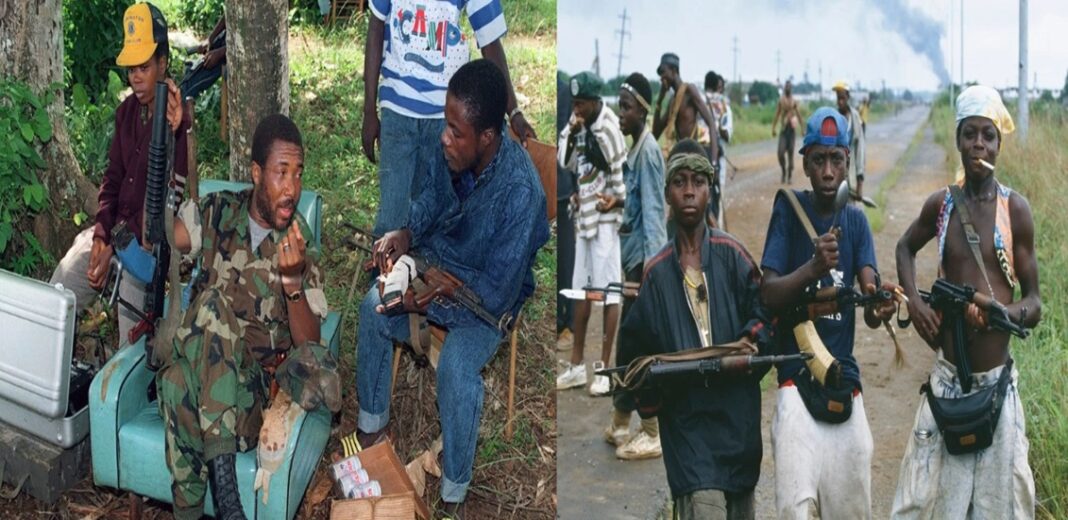
One of the most heartbreaking aspects of Liberia’s civil war was the involvement of children in the conflict. Reports from Operation Octopus reveal that young fighters were actively engaged in the assault on Monrovia. Human Rights Watch documented the use of boys and teenagers by the NPFL, including those associated with the Small Boys Unit.
It is deeply troubling to think of a nation sending its children into a war instigated by adults. Children should have been in classrooms, playing football in the streets, assisting their parents at home, or dreaming about their futures.
Instead, many were thrust into a harsh reality filled with weapons, fear, and violence, long before they could grasp the significance of the lives they were jeopardizing.
The tragedy is twofold: not only were children deprived of their childhood, but the country also lost the security and potential they embodied.
When a nation’s youth become tools of war, the repercussions extend far beyond the battlefield, affecting the future of the entire society.
What was the price for the struggle for power?
Operation Octopus was initiated with the aim of capturing Monrovia and challenging the defending forces. However, the NPFL failed to maintain lasting control over the capital. Instead, the offensive led to renewed fighting, a prolonged siege, and immense suffering for the local population.
This brings us to the unavoidable moral questions surrounding October 15, 1992. What is the value of a political victory when it results in homelessness, family separations, and an entire generation growing up in a climate of violence? What does it mean to pursue national leadership while the very people whose future is at stake are forced to abandon their homes? And what kind of political culture arises when armed conflict becomes the method for resolving disputes about governance?
These questions extend beyond a single faction or a specific moment in Liberia’s history. The civil war saw multiple armed groups involved, with documented abuses against civilians from all sides.
To remember Operation Octopus with integrity means recognizing the specific accountability of those who initiated the offensive, while also acknowledging that the broader conflict’s atrocities were not limited to just one side.
Howbeit, we must ensure that historical context does not serve as an excuse to downplay the suffering inflicted by any particular attack.
On October 15, 1992, the NPFL launched its assault on Monrovia, and civilians bore a horrific burden. This reality must be faced head-on, without avoidance.
Liberia must remember — not merely commemorate
Today, as Liberia moves forward from its civil wars, Operation Octopus serves as a stark reminder of the consequences when political conflicts escalate into military actions, often at the expense of ordinary citizens who become pawns in the ambitions of armed leaders.
Memory is crucial because peace can become so routine that people may forget how quickly it can be shattered. The generation that lived through the conflict recalls the fear, displacement, and sorrow.
In contrast, younger Liberians often learn about these events through family narratives, historical records, and survivor testimonies. Both groups have a vested interest in safeguarding the truth.
Liberia requires more than just commemorative messages; it needs a genuine commitment to educating its citizens about history, documenting survivor experiences, protecting democratic institutions, and ensuring that political disputes are settled peacefully and constitutionally.
Remembering also entails accountability. When credible evidence points to responsibility for atrocities, justice must be pursued in a fair manner, adhering to legal processes that honor the rights of both victims and the accused. Reconciliation cannot be built on a foundation of forgetfulness, and justice should not be driven by revenge.
The key takeaway is not for Liberia to remain forever haunted by its past, but rather to understand its history well enough to prevent repeating the same mistakes.
Never again
October 15, 1992, was not just a date marking a military offensive; it signified the return of large-scale conflict to Monrovia after a brief period of uneasy peace. This day highlighted the fragility of civilian life and illustrated how swiftly the quest for power can transform a capital into a site of horror.
The people who lived through those harrowing times deserve to have their stories honored. Those who perished should not be merely seen as statistics. Those who were forced to flee deserve a rightful place in the narrative of the nation. And the children who experienced the onset of violence deserve a future where the next generation is spared from such suffering.
Liberia cannot undo what happened on October 15, 1992. It cannot rebuild every home that was lost, reunite every family that was torn apart, or bring back every life that was taken.
Howbeit, it can choose what that date signifies for future generations. It can remember the perils of unchecked political ambition. It can reject the acceptance of violence as a norm. It can affirm that public leadership is a duty to safeguard lives, not a license to risk them.
Thirty-four years later, Operation Octopus should not be remembered solely because Monrovia turned into a war zone. It should be remembered for the suffering of its people, which laid bare the catastrophic cost of allowing war to overshadow politics.
The greatest tribute to those who faced October 15, 1992, is not another speech reflecting on the past. It is a Liberia where no leader, faction, or political ambition can ever again rationalize transforming the capital—or any Liberian community—into a battleground. This is the promise those living owe to those who are deceased. This is the duty that history imposes on the present. And this is the essence of the phrase “never again.”