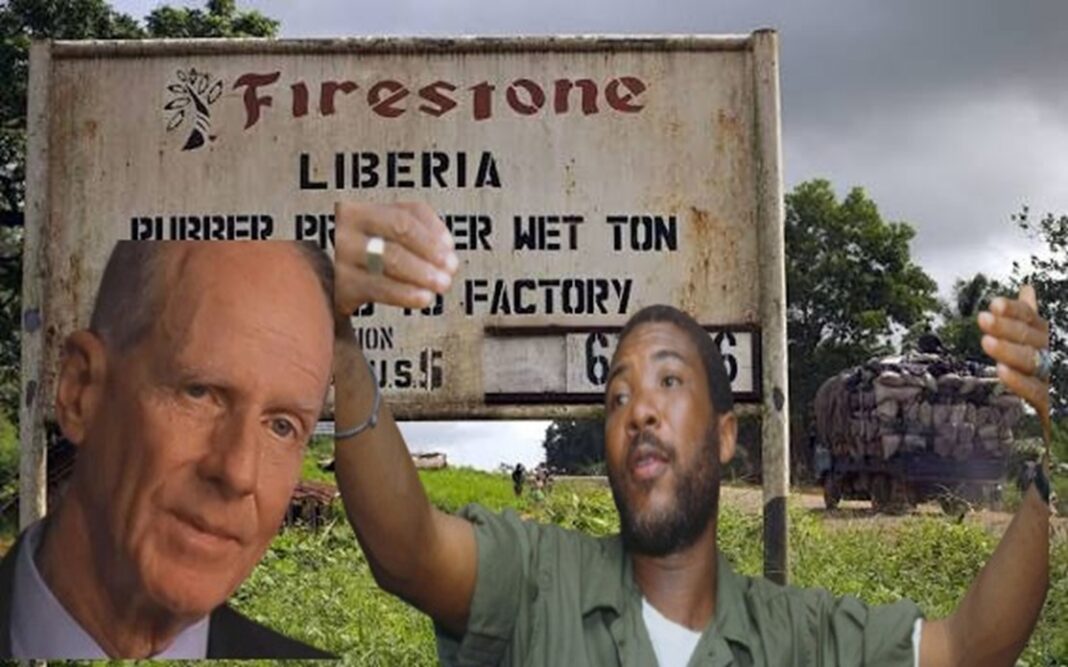
HARBEL, LIBERIA — October 8, 1992: Inside the Firestone plantation, where business, diplomacy, and Charles Taylor’s war intersected just a week before Monrovia was engulfed in flames.
The journey from Monrovia to Harbel was smooth, with twenty miles of paved road leading the convoy away from Liberia’s war-torn capital and into a landscape dotted with rubber trees, red earth, and industrial machinery.
At Firestone’s expansive plantation, signs of recovery were evident. Rubber production was back on track. In August, the plantation had yielded 600,000 pounds. By September, that number had skyrocketed to 3.9 million pounds. Over 6,500 Liberians had returned to work, and buildings damaged during the conflict had been restored. The plantation hospital was once again operational.
To an American diplomat visiting that day, it seemed like a glimpse of the normalcy Liberia so desperately needed.
Howbeit, beneath the surface, another narrative was unfolding among those trees—one that would erupt exactly seven days later.
On October 8, 1992, U.S. Ambassador William Twaddell made an official visit to the Firestone plantation. He was given a tour by Firestone’s management, which he later described as an impressive operation, believing he had gained a fair understanding of its workings.
Unfortunately, he had not seen the full picture. Behind the façade of industrial revival, Charles Taylor’s forces were using the plantation as a military base.
Taylor’s fighters were stationed at the plantation, and certain areas had been restricted for Firestone personnel.
According to diplomatic reports later reviewed by ProPublica and FRONTLINE, these restrictions seemed to hold military significance.
And indeed, Taylor was close by, getting ready for war.
THE RUBBER EMPIRE
Firestone had established its presence in Liberia back in 1926. Its plantation at Harbel had expanded into a vast economic empire, covering about 220 square miles at that time.
For Liberia, Firestone represented jobs, exports, infrastructure, and foreign exchange.
For Taylor, however, Harbel symbolized something different: it was all about money.
After taking control of the plantation during the civil war, Taylor’s forces gained access to a vital source of economic activity that could support his rebellion.
Taylor later stated that once his forces captured Harbel, Firestone became his “most significant principal source of foreign exchange.”
Thus, the plantation held a peculiar position in the Liberian conflict. It served as a workplace, a source of food and employment, an international business operation, and it was located in territory held by an armed group aiming to topple the interim government in Monrovia.
Firestone later claimed that the company had never willingly collaborated with Taylor and that its employees and assets were operating under the threat of armed forces.
However, investigators later found evidence of extensive financial and logistical connections between Firestone and Taylor’s rebel government.
ProPublica and FRONTLINE reported that Firestone provided resources such as food, fuel, trucks, and other materials, while payments were made to Taylor’s administration under arrangements the company described as taxes.
Firestone contested the notion that it had intentionally aided Taylor’s insurgency. This dispute would linger for years. But on October 8, 1992, the more pressing question was: What was Taylor planning to do with the plantation?
THE AMBASSADOR SAW THE RUBBER. THE REBELS SAW THE ROAD TO MONROVIA
During Twaddell’s visit, the usual flow of commerce persisted. Workers were busy tapping rubber trees, factories were processing latex, and managers were engaged in discussions about production.
It seemed as though the plantation was reviving after the war’s destruction. However, Taylor’s fighters were also present.
Subsequent investigations revealed that Taylor had repurposed parts of the plantation’s infrastructure into supply depots, utilizing Firestone’s facilities, communication tools, and other resources to strengthen his power.
Taylor’s involvement was not just political; it had military implications as well. The plantation’s strategic location was significant. Harbel, situated southeast of Monrovia, was near Roberts International Airport and along routes leading to the capital.
The same roads that transported rubber and workers could also facilitate the movement of soldiers. The plantation that generated foreign currency could support an army.
What appeared to be a zone of economic recovery could easily turn into a launch point for an attack. By October 8, this shift was already in progress.
SEVEN DAYS
The historical record marks October 8, 1992 with an unsettling significance due to the events that followed.
Just seven days later, on October 15, Taylor initiated Operation Octopus. The goal was to capture Monrovia, launching a full-scale assault aimed at toppling the Amos Sawyer-led interim government.
Taylor’s troops advanced on the city from various angles, using Firestone’s plantation as the base for their operations. Before dawn broke, the war erupted into Monrovia, with mortars and artillery raining down on the unsuspecting city.
The capital found itself encircled, civilians were forced to flee, and the United States Embassy faced imminent danger.
What began as a civil war escalated into something far more catastrophic.
Although Operation Octopus did not yield the swift victory Taylor had hoped for, it ushered in a new, brutal chapter in Liberia’s conflict, prolonging the nation’s agony for years to come. And lurking behind that offensive was Harbel—the rubber plantation, the factory, the roads, the money, and the men.
FOLLOW THE MONEY
To truly grasp the unusual role of Firestone during Liberia’s First Civil War, one must follow the money trail.
Taylor required resources for his fight, while Firestone was desperate to protect its investment.
Liberia, in turn, depended on the economic activity generated by the plantation.
Meanwhile, Washington sought stability in the region.
Civilians living near the plantation were in dire need of food, jobs, and security in a nation where the government was disintegrating. These conflicting interests converged at Harbel.
U.S. diplomats found themselves at odds over how Firestone should engage with Taylor. One former ambassador urged collaboration between Firestone and Taylor, while officials in Washington cautioned the company about the risks and potential legal ramifications of engaging with Taylor’s rebel government.
This led to an extraordinary situation where business continued in areas controlled by an armed insurgency.
It was not merely a tale of a corporation and a warlord; it was a complex narrative of competing interests caught in a failing state.
THEN CAME THE BOMBS
The plantation would ultimately turn into a battlefield. On November 2, 1992, West African allied forces targeted Firestone, resulting in over 40 fatalities and around 200 injuries.
What was once a symbol of Liberia’s industrial aspirations had now become a part of the war’s military landscape.
Firestone expatriates eventually left the plantation behind. However, the story didn’t end there. The company contemplated selling the plantation but later decided to resume operations after a board vote.
THE QUESTION THAT REFUSES TO DIE
Years later, the events surrounding Harbel would be scrutinized in courtrooms, diplomatic archives, and through investigative journalism.
Charles Taylor ultimately faced trial for war crimes and crimes against humanity linked to the Sierra Leone conflict. During his testimony, he referred to Firestone as a crucial source of foreign exchange for his movement.
Firestone, on the other hand, insisted that it had not willingly collaborated with Taylor, claiming that its actions were motivated by the need to safeguard its employees and property in areas controlled by armed rebels.
These conflicting narratives pose a challenging historical dilemma. Where does the line between survival and complicity blur when a corporation operates in a warlord’s territory?
And what happens when the economic lifeline of a community transforms into a resource for an armed group?
These questions are not mere abstractions in Liberia; they are deeply embedded in the very soil of Harbel.
OCTOBER 8, 19192
October 8, 1992, stands out as a haunting date in history. On that day, the American ambassador visited Firestone and witnessed a plantation seemingly revitalizing.
He observed workers bustling about, rubber being processed, and buildings being repaired, including a hospital that had reopened.
Howbeit, beneath this façade of recovery, something far more sinister was taking shape. Taylor’s fighters were gearing up, weapons were being transported, and the plantation’s strategic importance was becoming clear.
Just a week later, the sound of gunfire would shatter the calm. The road from Harbel to Monrovia would transform from a simple route for rubber transport into a crucial pathway leading to war.
October 8 was not merely the start of Operation Octopus; it was a more unsettling moment.
It was the day the world could gaze upon Harbel and see a business thriving, all while history was setting the stage for an assault on the capital.
Beneath the rubber trees, Liberia’s First Civil War was on the brink of one of its darkest chapters.